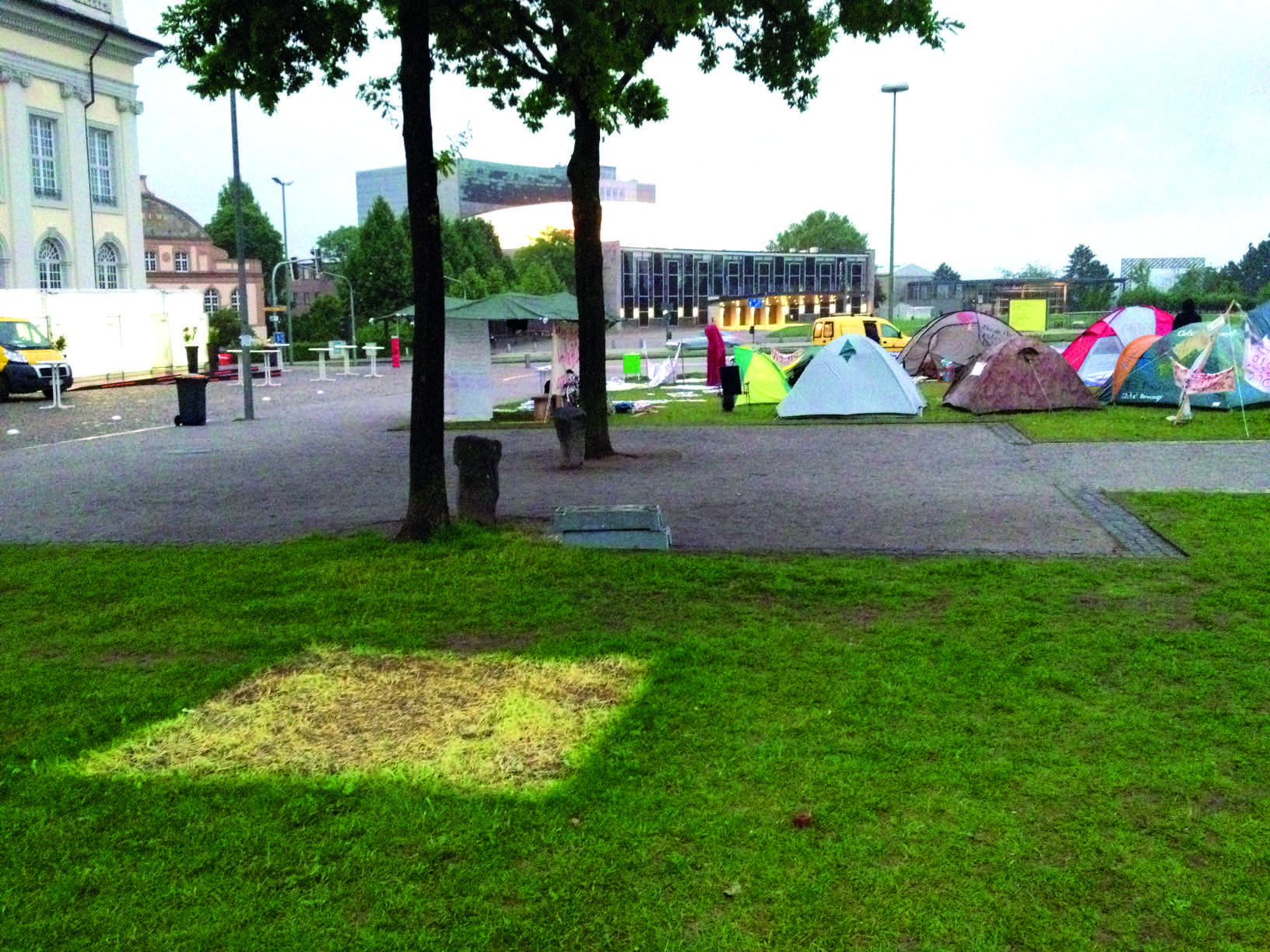
One of Thierry Geoffroy / COLONEL‘s most important tent artworks is now part of the collection of Kunsthalle Mannheim. For a couple of years ago, in close dialogue with the artist, Tijana Mišković wrote a text about this tent artwork for the book The Emergency Will Replace the Contemporary – Questioning the Structure.

Text from the book The Emergency Will Replace the Contemporary – Questioning the Structure, published in 2017 (ISBN 978-87-970047-0-8)
Tents as Artistic Expression
Thierry Geoffroy / COLONEL has been using tents as a form of artistic expression since 1991. His tents can be perceived as both paintings and sculptures, and can also be employed in performative interventions, created to stimulate debate.
The artist uses the sides of each tent as canvases, on which he paints statements. He generally uses spray paint, and the aesthetic of the written text expresses the artist’s impatient, disconcerting nervous energy at the moment of action. The shaky style of the text and uncorrected grammatical or spelling mistakes are intrinsic to the artistic intention, illustrating tension and speed. There is an authentic spirit of emergency captured in the tent artworks.
After the action part of the production, the tents become mobile sculptural objects. Each tent is placed according to its surroundings, so that the context of the place and the written statement on the tent become connected conceptually. Photos of the tents are thus not only documentation images, but can also be considered as visual artworks in themselves.
A tent structure inevitably recalls the state of emergency the world is facing, bringing to mind refugee tents, military tents, and tents as temporary shelters or protection from unforeseen disasters. The tent has become a globally recognised symbol for emergency and precarious living conditions.
Thierry Geoffroy / COLONEL’s tent artworks have been exhibited worldwide — at the Maldives Pavilion, Venice Biennale; ZKM Museum, Karlsruhe; Marta Herford – Museum für moderne Kunst, Herford; Kunsthalle Osnabrück. The tents are also in the collection of the Danish Museum of Contemporary Art, as well as in private collections in Paris, Copenhagen, Cape Town and São Paulo.

Ultrafast, Ultracontemporary and Emergency Art
Thierry Geoffroy / COLONEL’s artistic praxis is driven by the vision of creating awareness about dysfunction in the world through art. Since 1988, he has been working with art formats that support the production and presentation of artworks produced “in the now”. One of the earliest formats, ULTRAFAST, provided the setting for a series of exhibitions that were constantly changing — either moving in space or replacing older artworks with new ones each day.
The ULTRAFAST, pulsing way of working has not only to do with speed, but also with time. This is why the artist later introduced another term, ULTRACONTEMPORARY, linked more closely to the notion of time, and continuing his critical positioning towards the established understanding of contemporary art. Contemporaneity is an interesting phenomenon, because it forces us to make a connection between the self and time. Con + tempo (with time) alludes to some kind of togetherness or closeness to the present moment. Today’s understanding of “contemporary” has become so open that it incorporates all kinds of art made during or after the 20th century. By using the word Ultra and creating a new term, ULTRACONTEMPORARY, the artist brings the focus back to the time aspect and insists on contemporary signifying “in the now”.
The aspect of time is present not only in the artist’s decisions regarding methods and form, but also in the content of the artworks. Many burning topics need to be addressed urgently, before it is too late. The artist calls this kind of art “EMERGENCY ART” — art produced by artists who are constantly on the alert, recognising dysfunction and homing in on the most pressing global issues, using a triage system to rank emergencies as in a real hospital situation.
Thierry Geoffroy / COLONEL’s Questioning of the Contemporary Art Structure
Since 1988, Thierry Geoffroy / COLONEL has continually questioned large staged art events such as biennales, art fairs, and Documenta, through critical art formats such as BIENNALIST — a format that responds to and questions, through artworks, the motivations of biennials and other global art events.
He looks into these art events and their motivations, asking questions such as: Could 860,000 visitors have been intoxicated by an apathetic gas that keeps them from reacting? Are global art events designed to make people cry about something in order not to make them see something else? If the most important contemporary exhibitions in the world focus solely on past issues, how can we then expect art to be avant-garde?
With his art format BIENNALIST, Thierry Geoffroy / COLONEL takes the theme of each biennial seriously, studying it in order to contribute to the debate the biennales want to generate. In 2012, the BIENNALIST project was supported by the ZKM Museum of Contemporary Art for operations at the Athens Biennale, and by the Sprengel Museum for operations at the Venice Biennale. At dOCUMENTA (13), he realised the project “The Emergency will replace the Contemporary”, which received strong attention from the media and art critics.

How a Small Inoffensive Artwork Confronted the Great Contemporary Art Structure
The Emergency will replace the Contemporary is probably one of Thierry Geoffroy / COLONEL’s most important tent artworks, a convergence of the artist’s focus on emergencies and his critical approach to contemporary art structures.
This single unsolicited artwork managed to destabilise the established contemporary art structure of dOCUMENTA (13). Using the strategy as a brush stroke, the global art scene as his canvas and the emergencies of the world as his artistic motives, Thierry Geoffroy / COLONEL has developed a unique take on art, going beyond the notion of contemporary and opening up new fields such as EMERGENCY ART and ULTRACONTEMPORARY ART.
The main statement written on the tent artwork is “THE EMERGENCY WILL REPLACE THE CONTEMPORARY”. Its prophetic aspect makes us realise how the artist is not only able to grasp the importance of the now, but can also predict the future of contemporary art.
The critique of contemporary art’s ability to be “in time” is also expressed in the two other statements on the tent — “ART IN DELAY CAN NOT HAVE IMPACT” and “THE CONTEMPORARY IS ALWAYS TOO LATE, NEVER IN TIME”. The fourth slogan, “I AM NOT WORKING FOR THE TOURISM OFFICE”, questions the role of the artist, which unfortunately often has a utilitarian function with a predefined purpose, such as attracting tourists.
On June 6th, 2012, during dOCUMENTA (13), the tent was placed under one of Joseph Beuys’ trees from 7000 Oaks – City Forestation Instead of City Administration, on the lawn in front of Fridericianum, just after the press conference. This tent is today part of the art collection at the Danish Contemporary Art Museum in Roskilde.
A second tent was made the next day, June 7th, with the following statements: “THE EMERGENCY WILL REPLACE THE CONTEMPORARY”, “I AM NOT WORKING FOR THE TOURISM OFFICE”, “ART IN DELAY CAN NOT HAVE IMPACT”, and “THE CONTEMPORARY IS ALWAYS TOO LATE, NEVER IN TIME”. This tent created a chain reaction — on June 8th, two Chinese artists installed a tent on the same lawn, and on June 9th, the Occupy movement set up their own camp. On June 20th, the Belgian art magazine H ART published a picture of the artist’s tent on their front page.
By June 21st, the tent had been removed and confiscated by the dOCUMENTA organisers, later to be found in the basement of Fridericianum. The Occupy encampment was subsequently welcomed by the dOCUMENTA (13) curator on July 8th, given the tailor-made name dOCCUPY — clearly marking the fact that what should have been a resistance movement had been incorporated into the established and authorised system.


Questioning the Structure to Avoid Apathy
Ideally, artists should have an important position in our society as free and independent minds who can produce vital reflections about the socio-political conditions of the time we live in. Unfortunately, artists’ critical reflections are time and again used or misused for other purposes — promotion of products, gentrification, and cultural colonialism.
The only way an artist can avoid his or her role becoming purely functional is by constantly questioning the structures within which the art is being presented. Biennales and large-scale exhibitions such as Documenta should, as the most influential contemporary art structures, be a natural object for investigation.
Documenta can be considered as a “Vatican” of contemporary art — promoted as the quintessential platform for critical thinking and political statements. Large-scale art events such as Documenta and the Venice Biennale have an enormous international impact and great power to influence public opinion. This influence should be evaluated not only by participating artists, but also by the audience, who should question the motivations behind curatorial strategies rather than merely absorbing the messages communicated to them.
Curating goes hand in hand with filtration. Certain topics, artworks and artists are highlighted as central, while others are relegated to a peripheral position or go unmentioned. Furthermore, curating always includes an educational element which facilitates learning and the acquisition of knowledge, values and beliefs — placing the curator or institution in a position of power to shape interpretation.
A delay in contemporary art could also be seen as a diversion strategy. Artists cannot show art connected with the pulsing and unpredictable present, since all exhibited artworks have to be defined, produced, and explained in advance. This self-censorship makes it difficult to achieve an authentic and honest artistic intention — and is more difficult to identify or fight than direct censorship, since it is an embedded control function that contemporary art carries in the DNA of its structure.

A “critic show” can give the public a feeling of being critical, while at the same time drawing attention away from vital issues that authorities do not want to create critique around. If the lack of real concern for making a change infiltrates the art community — and what we consider the avant-garde force in our society falls asleep — we risk our world heading in the direction of narrow-minded, or even totalitarian thinking.