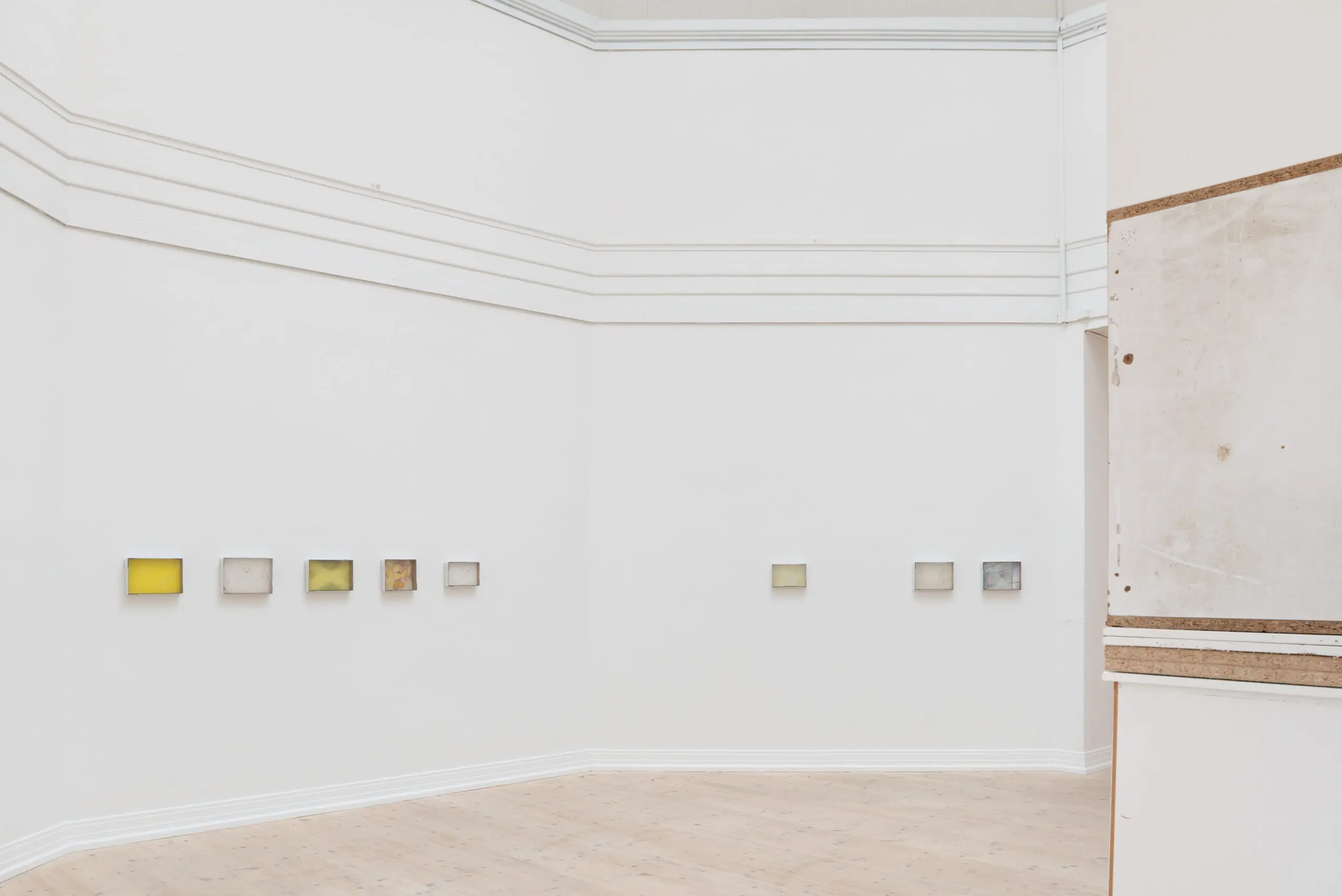
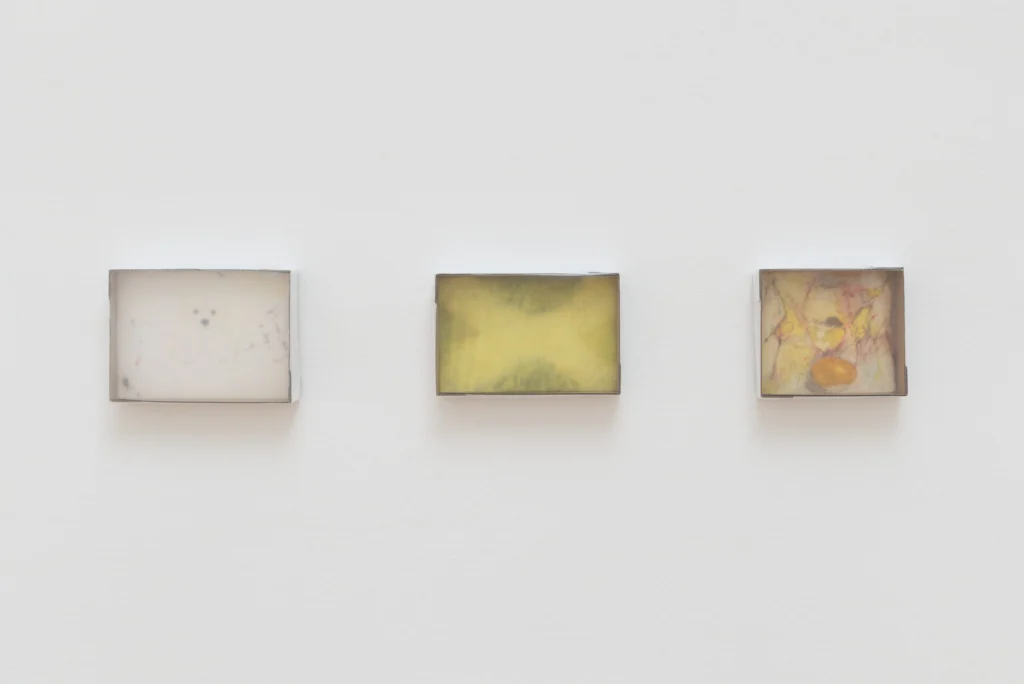
Afgang 2025 marks the moment when seven Jutland Art Academy graduates step into life as professional artists. Across diverse media and conceptual approaches, they present works that investigate and call attention to the often overlooked structures that shape our relationships with urban space, architecture, body, people, and the objects around us. By exploring the boundaries between the private and the public, the fictional and the real, the obvious and the subtle, this new generation of visual artists invites us to reflect on the social structures that shape our everyday lives – and perhaps even our worldview.
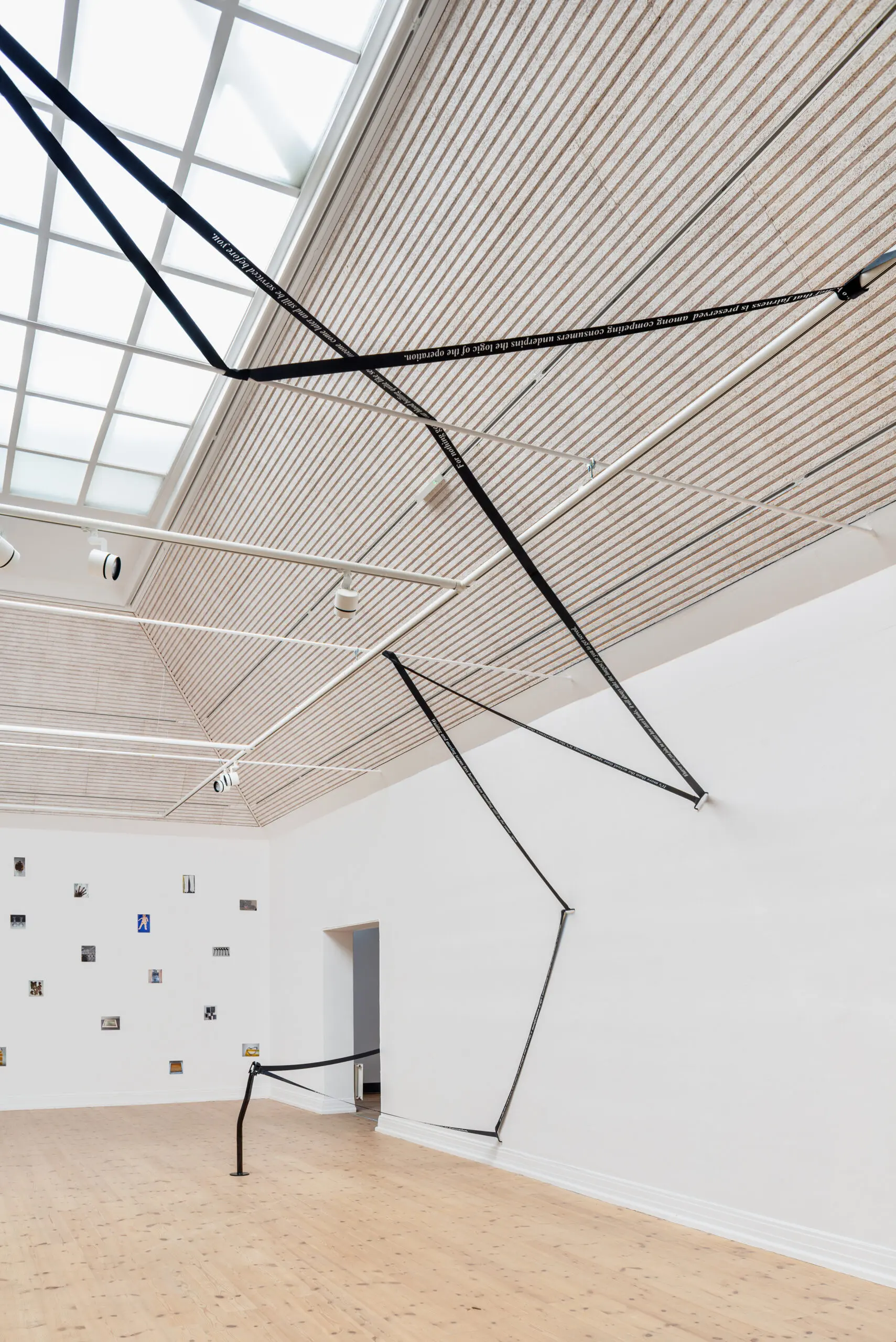
The audience is guided into the exhibition by Agnes Olivia Schyberg’s barrier tape with printed text excerpts from queue manuals. The audience’s progress through the space is directed and restricted, evoking the complex and contradictory systems of control that govern our behaviour, both individually and collectively.
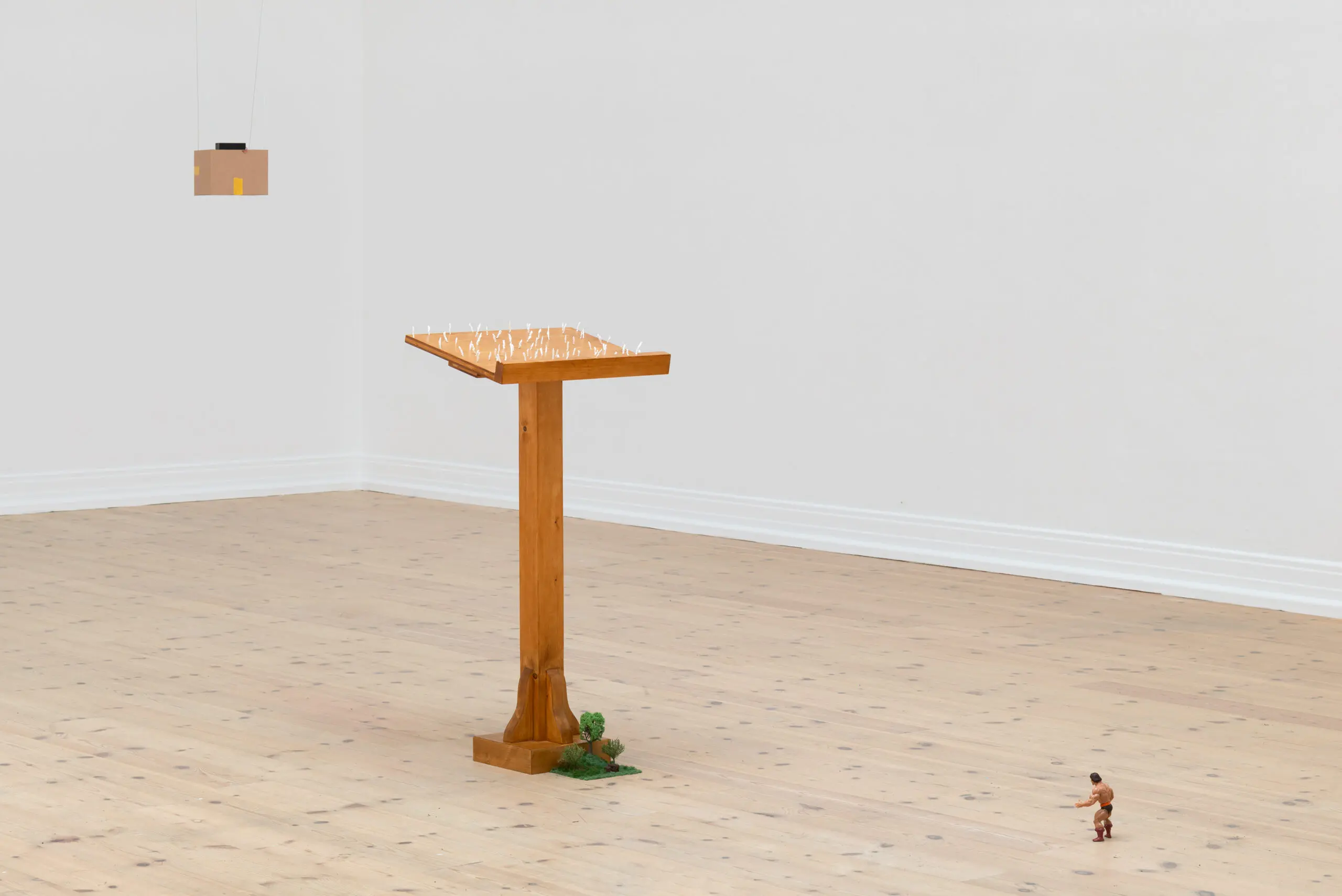
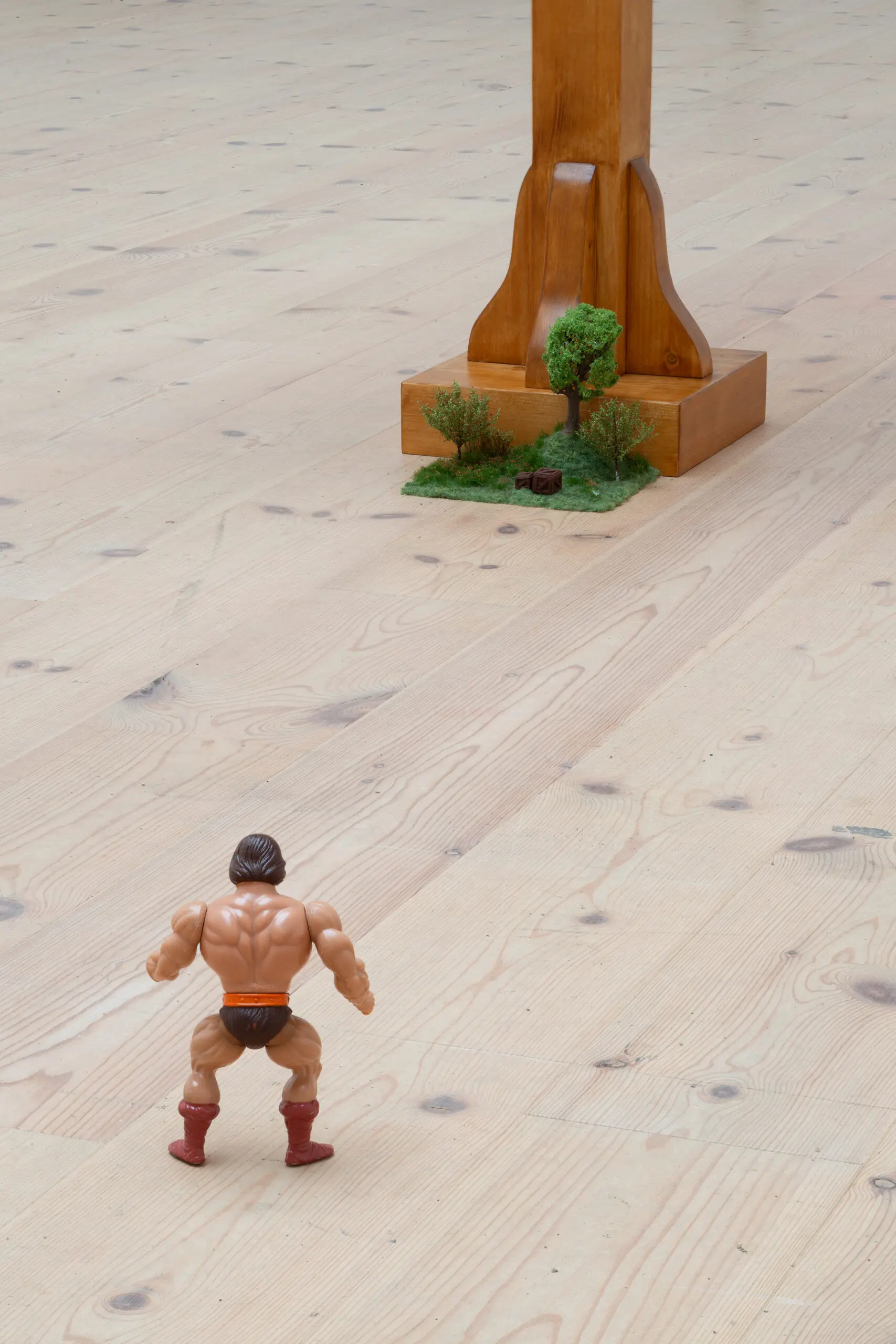
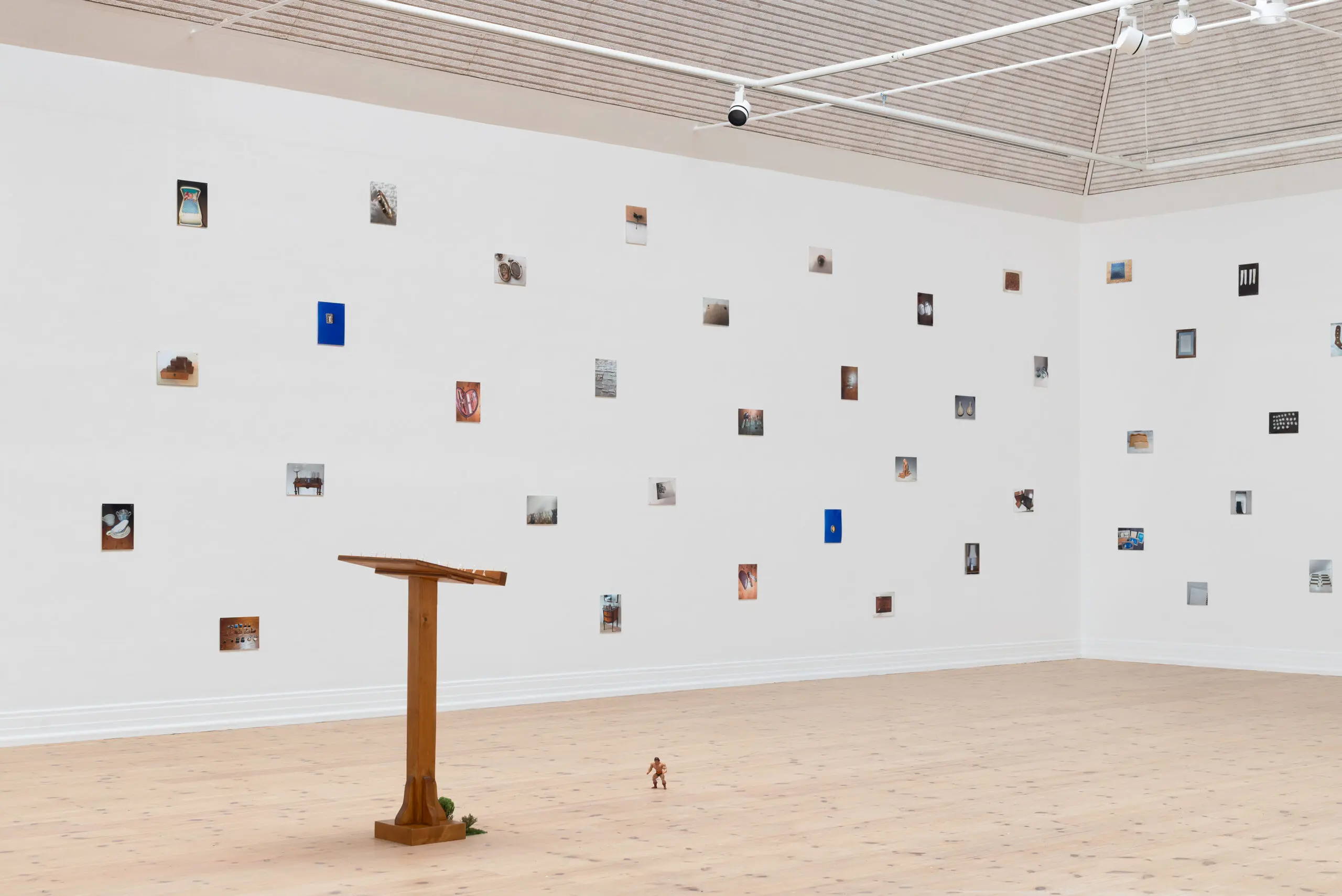
In the same room we find William Valentin’s not-quite-ordinary rostrum. The speaker has been replaced by a miniature landscape, and nearby is a peep box with a small hole revealing a painted landscape inside. These components are crafted at markedly different scales, yet despite their differences in size, they appear to function within a shared universe. What kind of lecture or speech is being given here? Is the message conveyed in words or in images?
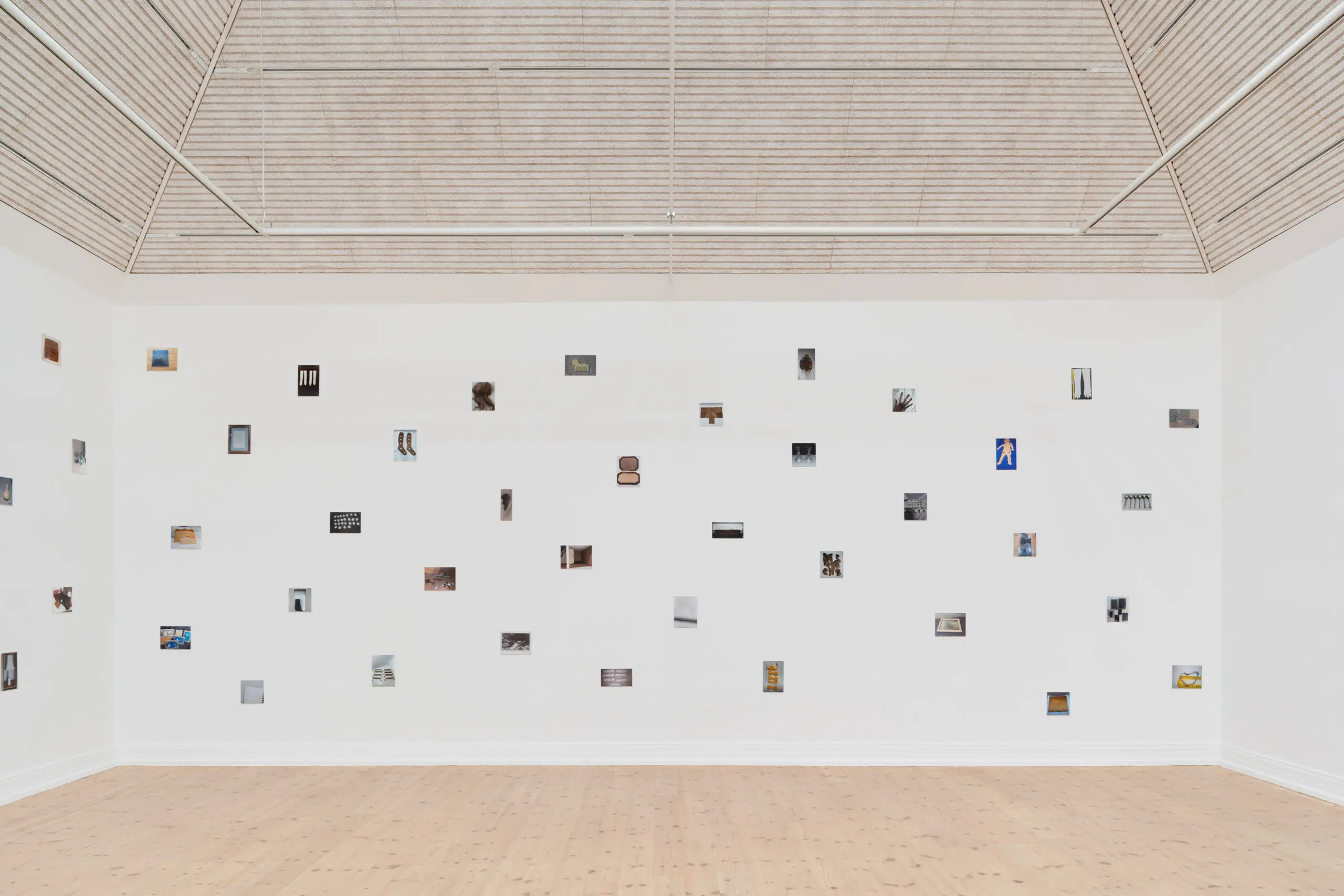
Images are precisely what Amalie Götz focuses on in her work, exhibited in one corner of the same exhibition room. She uses amateur photographs of objects sourced both from online marketplaces and her own family collections. By creating collections and archives, she explores how photographs and objects act as carriers of memory – and how their value shifts as they change hands or contexts.
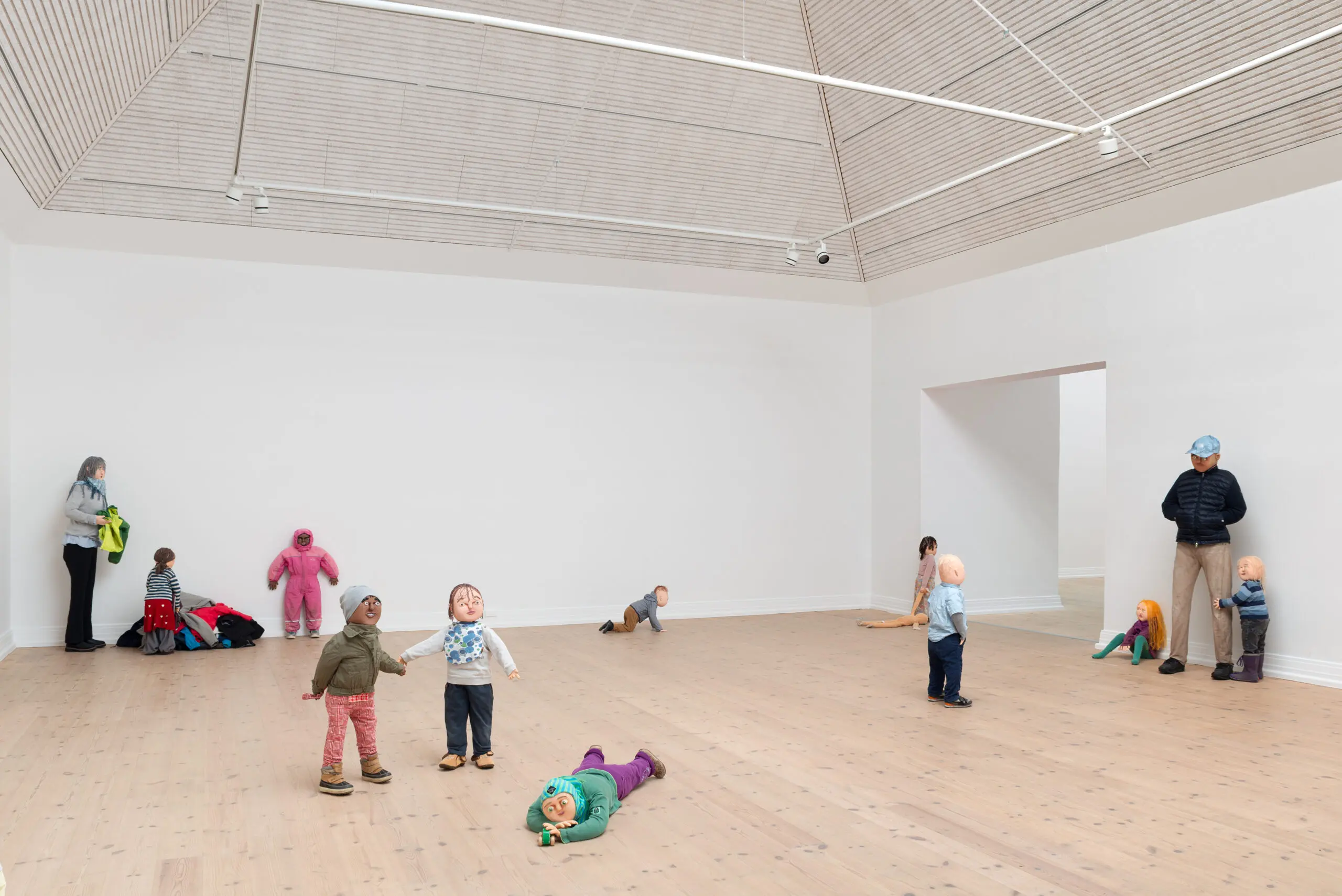
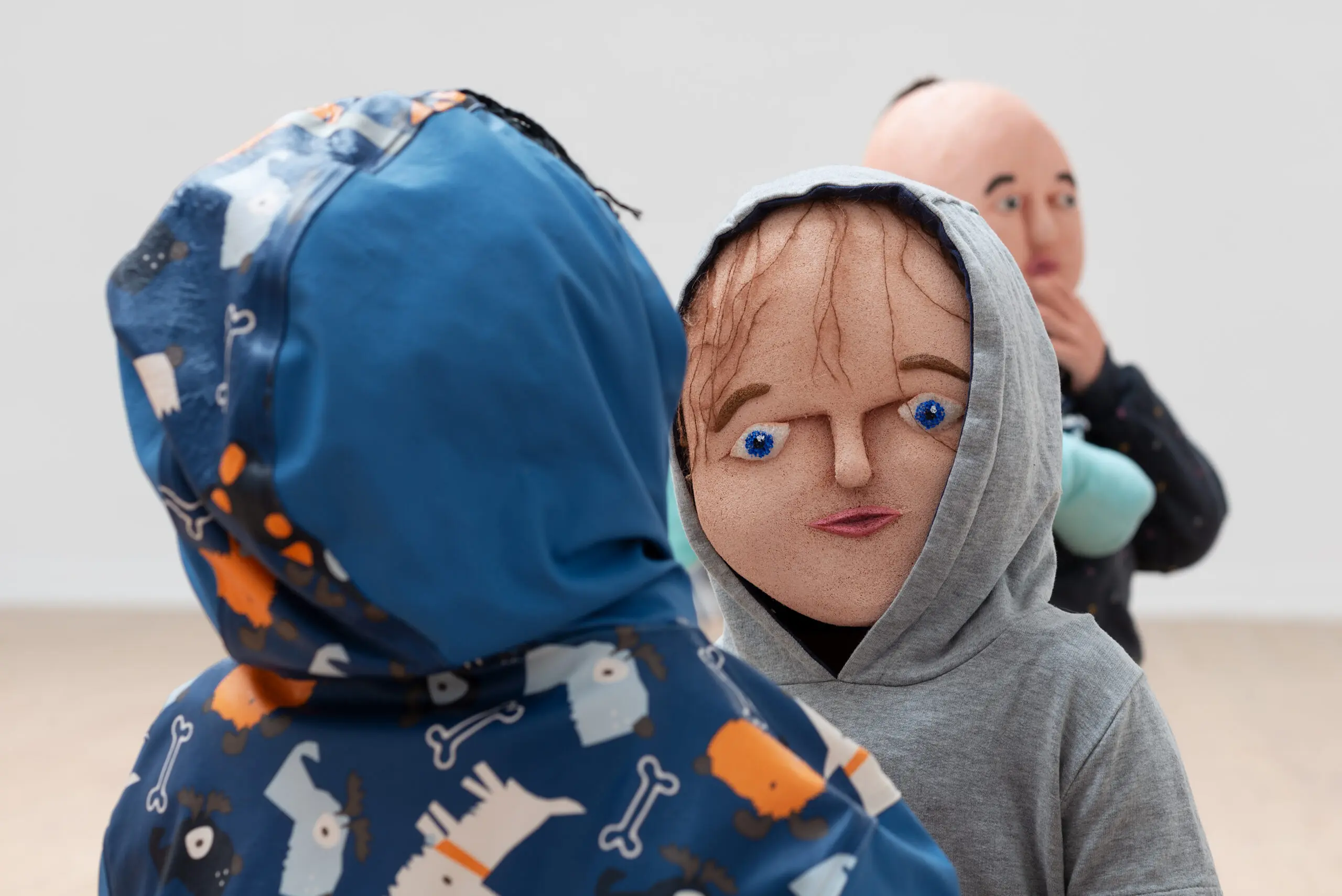
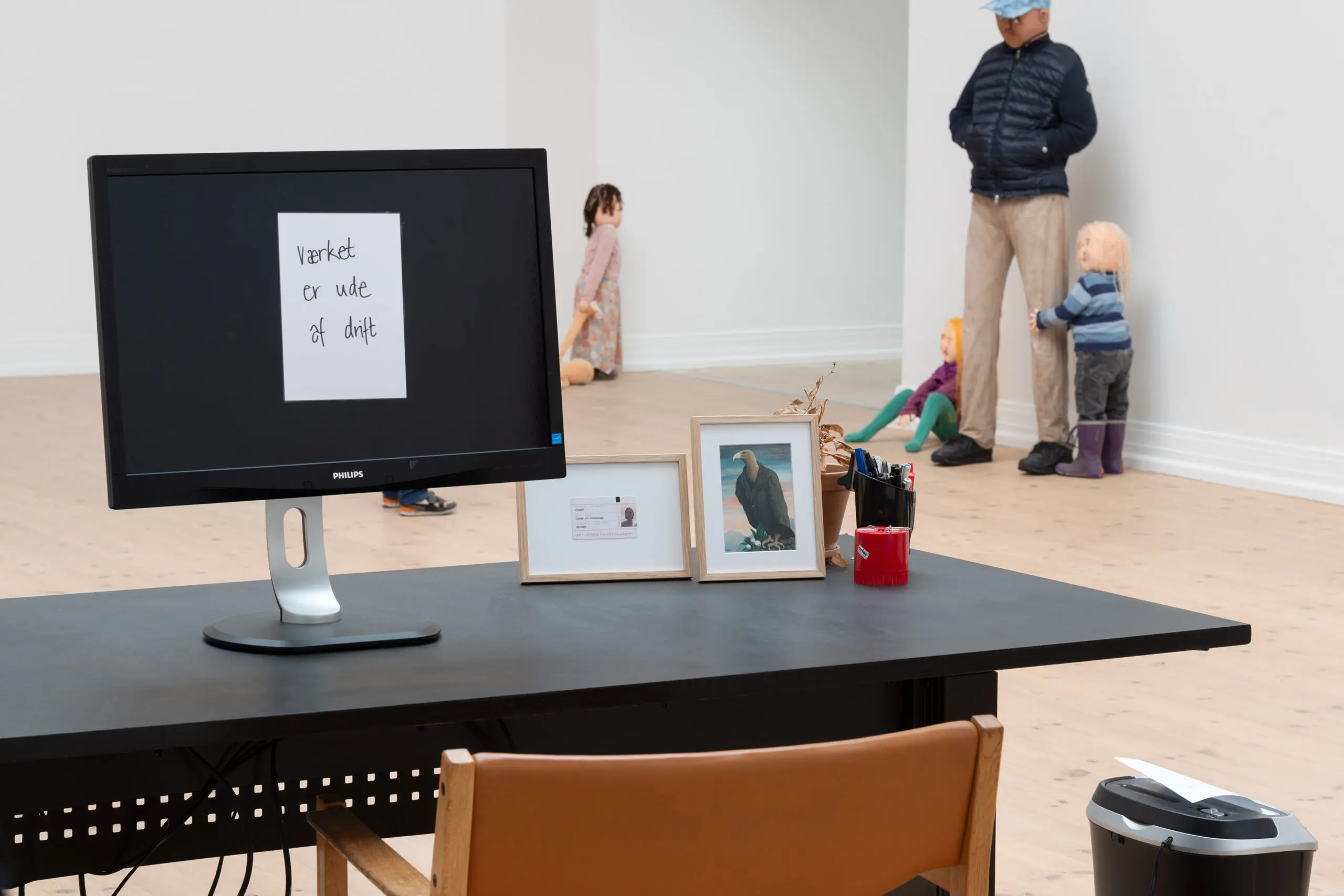
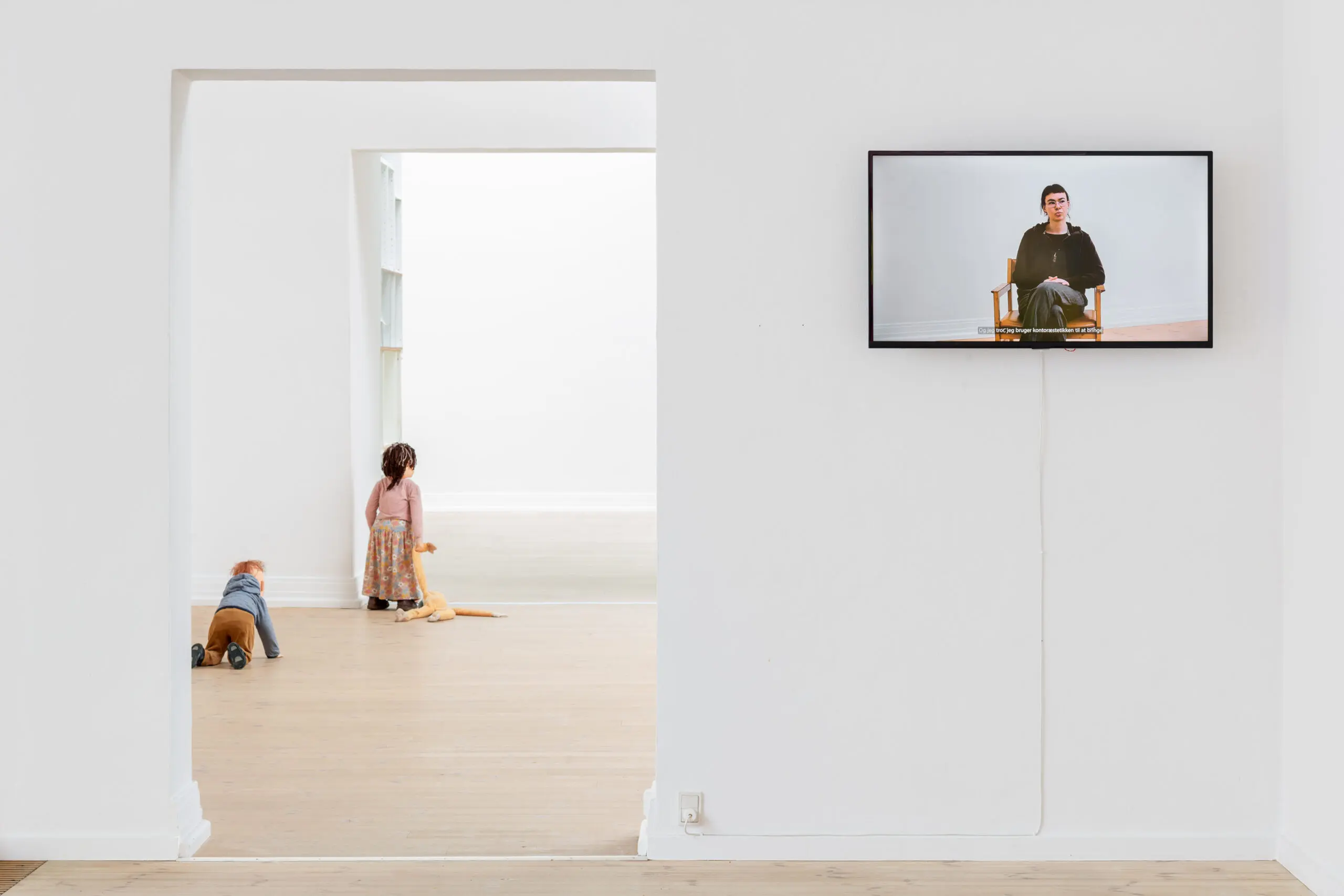
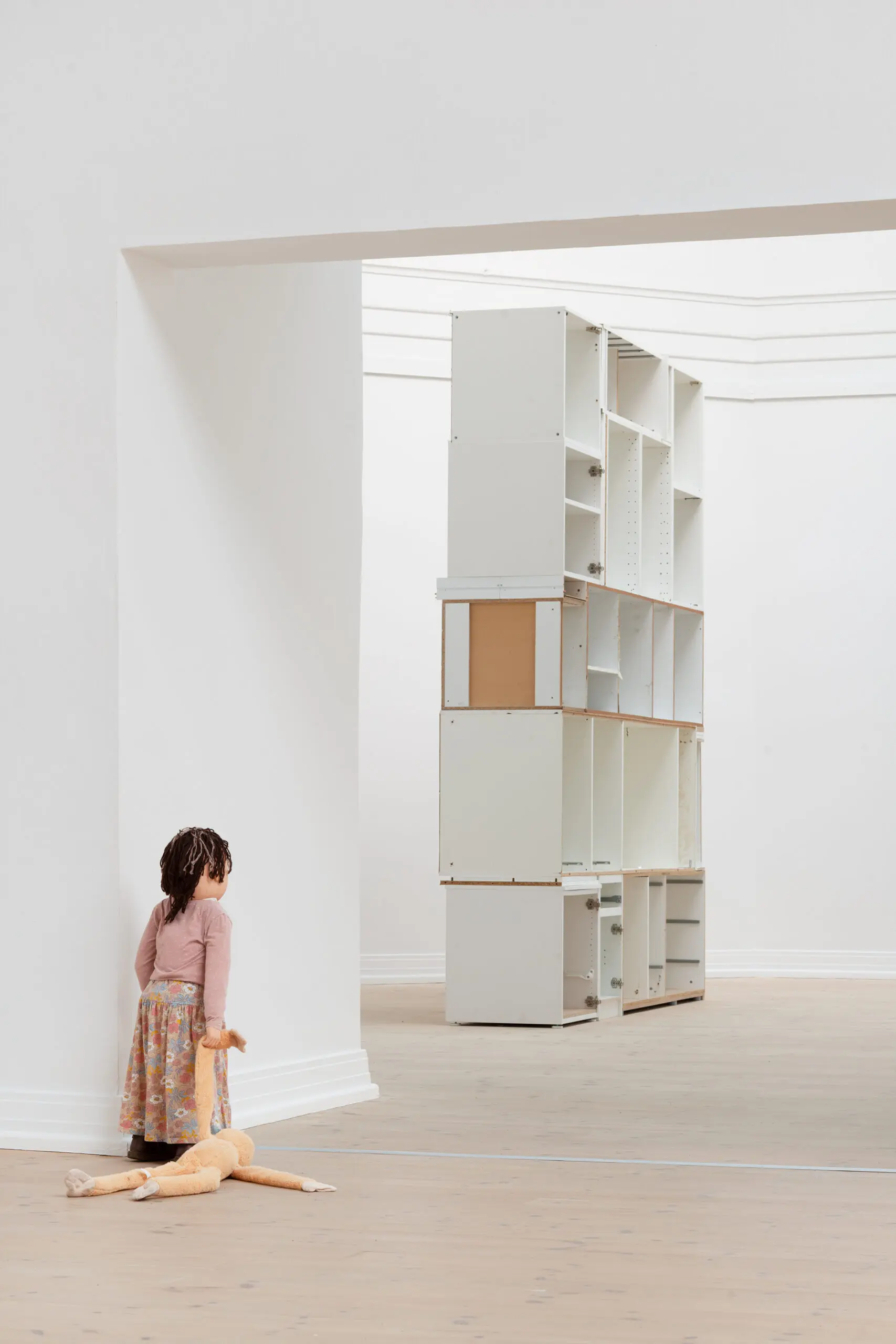
From collections, we move to communities. In the second exhibition space, Sebastian Møller Jørgensen presents life-sized figures of 24 kindergarten children and four teachers. In a very immediate and grounded way, the work portrays one of the essential social communities that – for better or worse – shape the child, the individual, and the citizen. Here, the kindergarten is simply on a field trip to view the graduation exhibition.
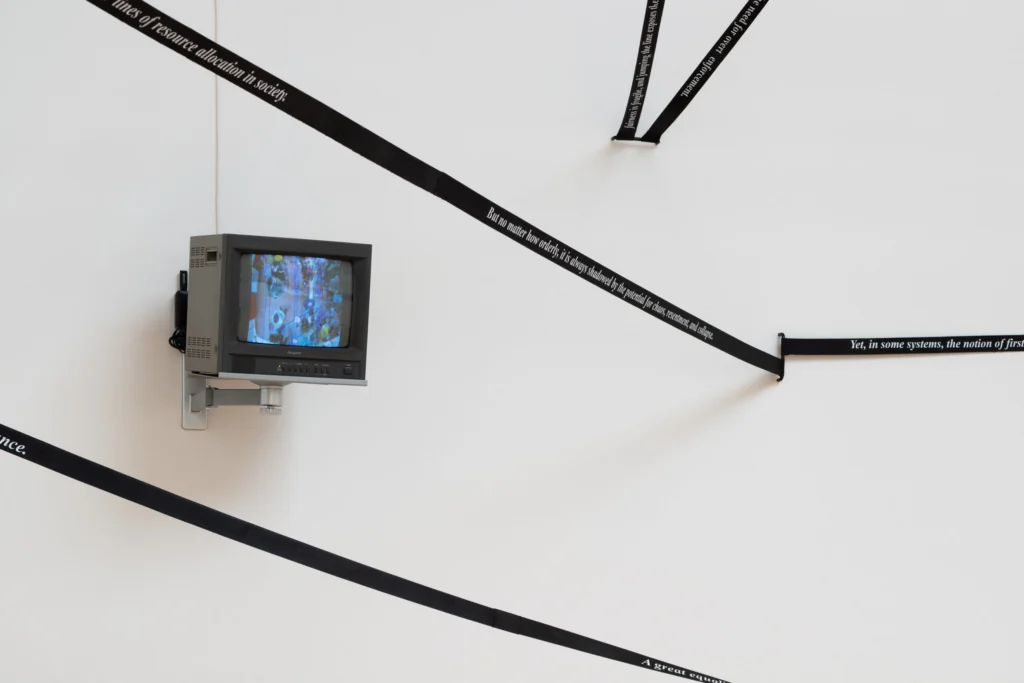
Cecilie Julie Holst Christensen takes the graduation exhibition itself as a starting point – the structural framework in which she and her peers find themselves, and which is also part of the contemporary art scene. Through ready-made installation, video work that mimics institutional info video, and both announced and unannounced performances, she moves inquisitively between documentation and fiction – perhaps to draw attention to the fragile position of arts in the here and now.
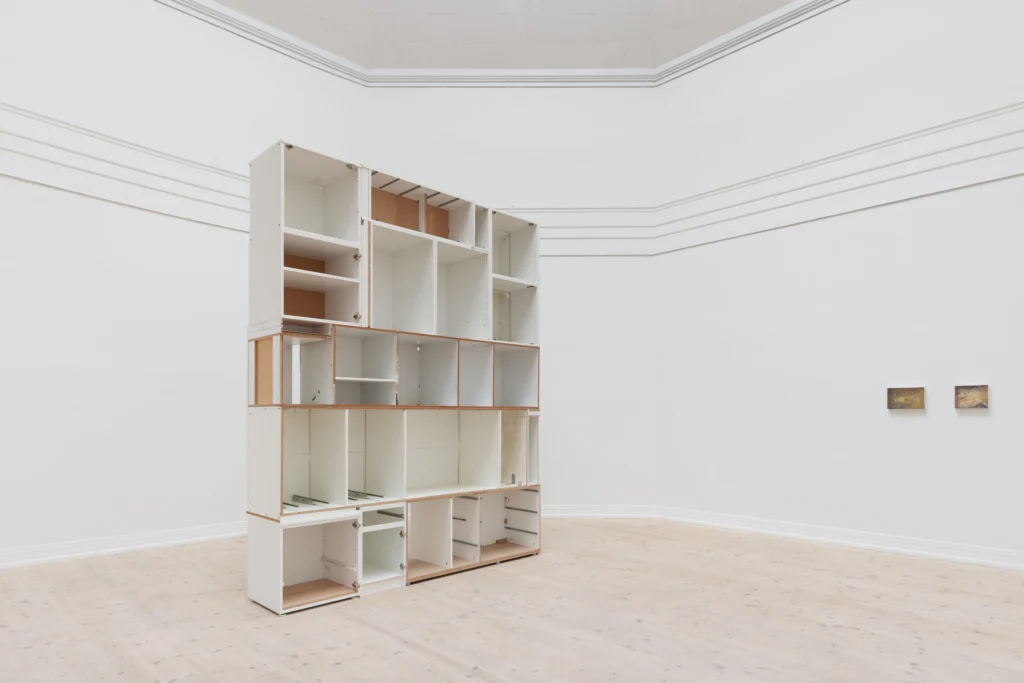
In the adjacent room, Tine Simonsen Antonius also explores the complexities of perception, but through absence. She is concerned with the absence of function, of motif, and of space. With works like a modified storage unit that no longer stores anything, her investigation points back to the very subject of its inquiry. One might say that by accumulating or condensing absence, she renders it visible.
The relationship between the visible and the invisible is also central to Andrea Glahn’s works in the same room. She draws on the concept of ‘shadow boxing’, which refers both to fighting an invisible opponent and to the packing technique used to transport especially fragile artworks. These references are woven into a series of drawings that take their starting point in the duality of autoimmunity: protection and destruction.
Throughout the exhibition, one senses a sincere registration and exploration of the structures, systems, and dynamics that – directly or indirectly – affect our bodies and minds, our communities, our art institutions, and our society. These seven young artists help us become aware of the mechanisms we are all a part of. And that is exactly what a new generation of artists should do: create new ways of perceiving, casting the familiar, enabling new nuances to emerge.
Photo: Jacob Friis-Holm Nielsen
Curatorial notes:
Back in the summer of 2024, I was asked to curate the graduation exhibition for students at Jutland Art Academy. My first thought was that it seemed like a strange curatorial task – mainly because, as a curator, I did not have the option to choose the artists or artworks to be presented. The fact that I usually do not work with such young artists added to my hesitation. But the experience turned out to be anything but strange – and now I can say I have worked with young, budding and promising artists.
The encounter with them was marked by warmth and sincerity – a sincere meeting, where the students generously shared their thoughts and ideas, as well as their doubts and concerns. Our meetings were dynamic. We started by discussing ideas, words, and texts. Later, we moved on to mull over images, sketches, and artworks. And finally, we had to consider the exhibition space, the nature of a graduation show, and the art scene in general.
For me these meetings resembled a multi-leg journey where each stage sparked new, valuable exchanges, both on a professional and a personal level. Looking back, I am indeed glad I accepted this curatorial task and I feel truly grateful for the encounters it enabled.
The following are short letters that I have written to each of the seven talented young artists I met – and that I hope to meet again and again.