
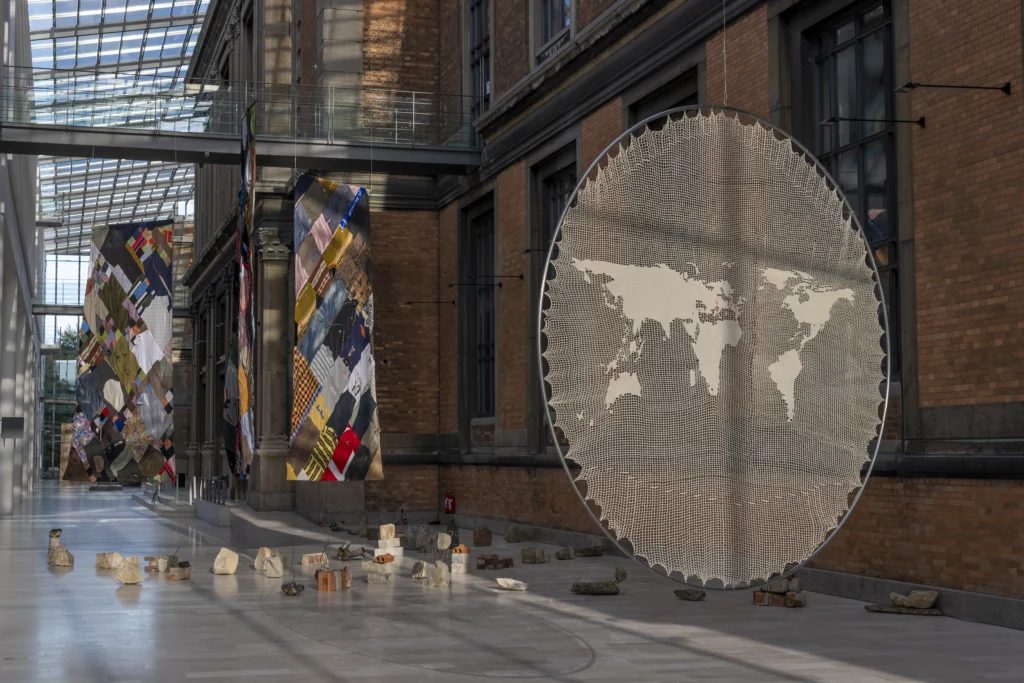
War, migration, asylum policies and the feeling of home: in the autumn of 2022, seven leading Danish artists from the former Yugoslavia entered SMK – the National Gallery of Denmark with their political and deeply personal works of art. The exhibition was curated by Tijana Mišković.
In 2022, exactly 30 years had passed since Denmark received 20,000 refugees from the wars in the former federate country of Yugoslavia, primarily from Bosnia and Herzegovina. In the 1990s, the wars sent over half a million people into exile, creating what was at the time the most challenging refugee situation in Europe since World War II.
Many of those refugees subsequently chose to stay in Denmark, and today the Danish contemporary art scene includes several prominent artists from the former Yugoslavia. In the exhibition, SMK brought together seven of these leading artists. With a few exceptions, they all came to Denmark as children when their families fled from the war in the Balkans.
The Artists
Alen Aligrudić, Amel Ibrahimović, Ana Pavlović, Ismar Čirkinagić, Nermin Duraković, Suada Demirović, Vladimir Tomić
The artists in the exhibition shared a similar multicultural background, but they worked in vastly different ways. In the museum’s long Sculpture Street, visitors would find a monumental work consisting of six-metre sails sewn out of clothes collected from refugees in fifteen countries ravaged by conflicts.
Also on display were crocheted world maps, photographic postcards from a country that no longer exists, and the video work Flotel Europa, which tells the story of the ship that, back in the 1990s, functioned as a refugee centre in the heart of Copenhagen.
Curatorial approach
As curator Tijana Mišković says:
“In a time of exile and involuntary migration, it is important to focus on the connections that can arise between different cultures, histories and geographical areas. Art can create meaningful connections across the gulf created by migration.”
The exhibition did not set out to tell a single story. Rather, Mišković took the individual practices as a point of departure — responding to seven specific bodies of work and the very different stories behind them. Some artists came to Denmark as teenagers and work primarily with the experience of war itself. Others, who arrived as young children or were born in Denmark to parents who migrated earlier, work with inherited narratives: with cultural affiliations that exist without personal memory, and with the experience of diaspora as something passed down rather than directly lived.
The result is an exhibition that draws parallels not only to the Balkans in the 1990s, but to the universally human experience of displacement, identity, and belonging across conflicts, times, and geographies.
Programme and legacy
The exhibition was accompanied by the academic seminar Transcultural Connections: Art in Socialist Yugoslavia / Art in Today’s Migrations, organised in collaboration with the University of Copenhagen (November 2022), and a Wikipedia edit-a-thon that resulted in new Wikipedia articles covering all seven exhibiting artists. Following the exhibition, works by Ana Pavlović and Vladimir Tomić entered the permanent collection of SMK.
For more information, visit the SMK exhibition page.