
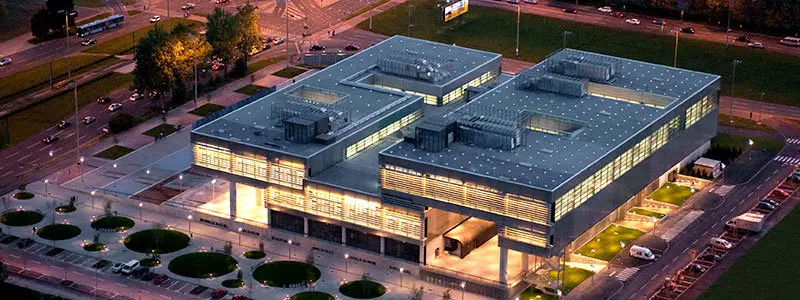
The Eighth Sea at MSU – Museum of Contemporary Art Zagreb is a solo exhibition by Ismar Čirkinagić featuring four new works by the artist. The exhibition takes as its point of departure places marked by war, environmental degradation and deep social divisions, exploring how human actions become inscribed in the landscape. Čirkinagić approaches nature not merely as a place of beauty or a neutral backdrop to human conflict and destruction, but as a space that remembers and silently bears witness. Plants, water, shells and seemingly tranquil landscapes carry histories whose traces are not always immediately visible.
The title The Eighth Sea refers to an imaginary eighth sea, extending the expression ‘the seven seas’, historically used as a metaphor for the entirety of the known world. This eighth sea exists on no map. Instead, it emerges as a mental landscape shaped by the consequences of human ambition and exploitation, where borders, political conflicts and ecological destruction converge on a horizon without direction.
Drawing on John Milton’s Paradise Lost, the exhibition considers contemporary humanity’s loss of orientation – not in a religious sense, but in ethical, political and cultural terms. It asks whether humanity has been expelled from Paradise, or whether the world has been changed so radically by our own actions that we are no longer able to recognise it.
Photo © Vanja Babić


Camera Obscura is a two-channel video work based on the optical camera obscura principle, one of the pioneering techniques in the development of photography. In a darkened space, light penetrating a small opening projects an image of the outside world onto the opposite surface. The projected image appears inverted, turning the familiar landscape upside down.
The work presents landscapes that have been the scene of mass graves and violence in Bosnia and Herzegovina, Spain, Guatemala and Cambodia. At first glance, these are quiet, almost idyllic natural environments, offering few, if any, visible indications of the events that took place there. This contrast between what can be seen and what remains hidden is central to the work.
By subjecting these sites to the optical inversion of the camera obscura, Čirkinagić subtly unsettles their apparent tranquillity. What initially appears peaceful becomes disorienting, while the simple act of turning the landscape upside down introduces a sense that the order of the world itself has been disturbed. He takes this inversion a step further by transforming the inverted image into a negative – an artistic intervention that goes beyond the optical properties of the camera obscura. The intention of the work is not to reconstruct or directly represent the events associated with these sites. Instead, the landscape becomes a silent witness, carrying accounts that remain present even when they are no longer visible to the naked eye.


The Eighth Sea brings together seawater collected from seven different seas. Presented in transparent five-litre containers arranged on seven industrial metal shelving structures, the water is separated and organised according to its geographical origin. The installation evokes the nomenclature of a scientific or oceanographic collection, in which a vast and fluid natural entity is contained, divided and classified.
Drawing on ‹the seven seas› as an ancient metaphor for the whole known world, the work introduces an imaginary eighth sea – one that exists beyond geography and which has no fixed location on any map. It unfolds as a mental landscape shaped by human ambition and exploitation, where human-drawn borders, political conflicts and ecological destruction converge.
The act of collecting and containing sea water creates a tension between the sea’s natural fluidity and the structures imposed upon it. Here water that circulates, merges and defies fixed boundaries is apportioned into individual containers and assigned to distinct geographical categories. The bringing together of seawater from different seas, while keeping it physically separated, points to a human impulse to divide, classify and control a world that is fundamentally interconnected. The imagined eighth sea emerges from this paradox – a metaphorical space in which established boundaries and coordinates are losing their meaning, and where the search for orientation simultaneously becomes geographical, political and existential.


Herbarium consists of 90 individually prepared herbarium sheets displaying plants collected at sites associated with mass violence. Each specimen is dried and preserved on acid-free paper and accompanied by a handwritten label recording its scientific name, location and date of collection, as is customary in traditional botanical collections. But Čirkinagić adds one further piece of information – the number of bodies found at the site. In this way, the work adopts the visual language and classificatory methods of the traditional herbarium while connecting them to landscapes shaped by narratives of violence and death.
The work originated in Bosnia and Herzegovina, where, between 2004 and 2022, Čirkinagić systematically collected plants from mass-grave sites in and around his hometown of Prijedor. The series presented at MSU marks a significant development of Herbarium – for the first time, Čirkinagić extends the project beyond Bosnia and Herzegovina, bringing together specimens from sites marked by different experiences of mass violence across three continents.
The plants do not document the events associated with these places directly, nor do they act as metaphors for them. Their significance lies instead in their provenance – each specimen originates from a specific site whose history may no longer be visible on the surface of the landscape. By preserving and classifying these plants according to the standards of botanical science, Herbarium brings scientific observation into dialogue with acts of violence, memory and absence.


Snapshots from the opening reception where a special diplomatic moment also took place: the Mayor of Zagreb, Tomislav Tomasevic and the Danish Ambassador to Croatia, Anne Toft Sørensen signed a Letter of Intent to strengthen cultural cooperation between the City of Zagreb and Denmark.
Photo (opening) © Vedran Benović


A PDF version of following material can be downloaded her:
ISMAR ČIRKINAGIĆ — THE EIGHTH SEA
17 September – 8 November 2026
Museum of Contemporary Art, Zagreb
Venue: Museum of Contemporary Art Zagreb, Avenija Dubrovnik 17, 10000, Zagreb
Exhibition dates: 17 September – 8 November 2026
Artist: Ismar Čirkinagić
Curators: Vesna Meštrić (MSU) and Tijana Mišković
Producer: Morana Matković (MSU)
Support: The exhibition has been realised with the support of the City of Zagreb, the Ministry of Culture and Media of the Republic of Croatia, the New Carlsberg Foundation, the Danish Arts Foundation, the Danish Agency for Culture and Palaces, the Royal Danish Embassy in Croatia, the Knud Højgaard Foundation, Culture Moves Europe and Akademiraadet – the Danish Academy Council. In collaboration with Three Points.
Special thanks: For their expertise and assistance with the artwork The Eighth Sea, special thanks go to Dario Omanović and Mirta Smodlaka Tanković at the Centre for Marine Research, Ruđer Bošković Institute; Lars-Eric Heimburger-Boavida and Daniela Bănaru at the Mediterranean Institute of Oceanography; Sotiris Karavoltsos at the National and Kapodistrian University of Athens; Andreia Rodrigues at CESAM and the University of Aveiro; Florin Timofte at the National Institute for Marine Research and Development “Grigore Antipa”; Sune Riis Sørensen at DTU Aqua; and Jesper Sandager aboard the research vessel DANA. For their assistance with Herbarium, special thanks also go to Vanja Nikola Stamenković at the Botanical Garden, University of Zagreb; Associació Memòria de Mallorca; Choeung Ek Genocidal Center; and Ester Miza in San Juan Comalapa / Chi Xot