
Each day in July 2019, Tijana Mišković highlighted one artwork by an artist from former Yugoslavia who left the country after the 1990s — artists whose works she finds particularly relevant in relation to the phenomenology of place and the expanded notion of belonging, including the concept of inbetweenness.
July 31st
Artwork: Fabrics of Socialism (Fototeka), 2015
Artist: Vesna Pavlović
Text related to the exhibition at The University Art Gallery: vesnapavlovic.com
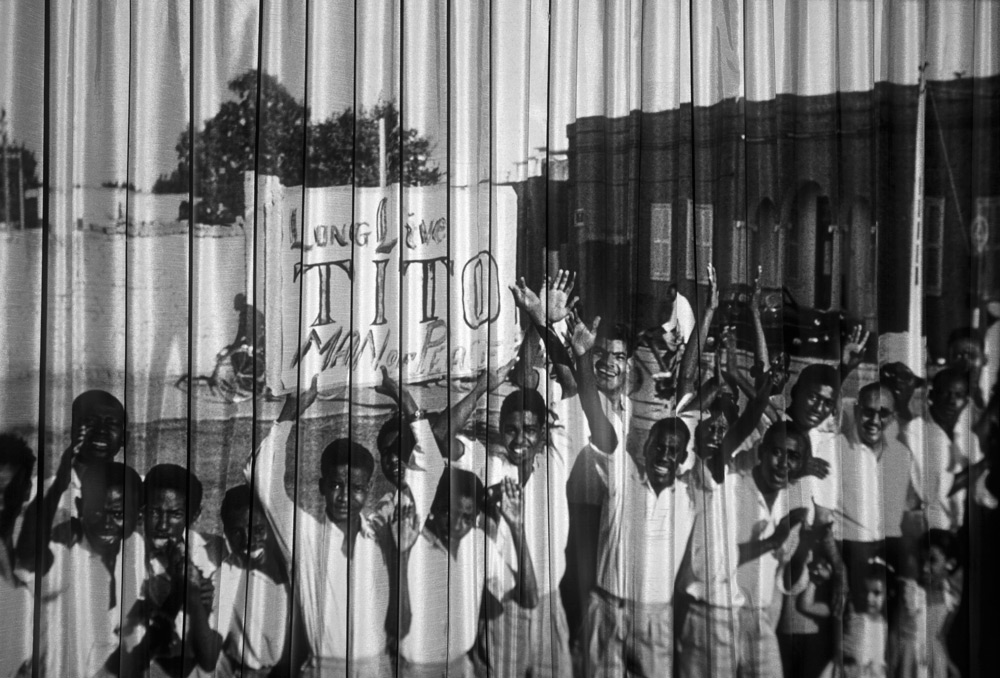
Pavlović mines the archive of the former Yugoslavia to explore propaganda and collective memory, the medium of photography and the life and obsolescence of media. Offering “a psychological portrait of an era burdened with photographic representation of socialist propaganda,” Pavlović invites visitors to consider the role of photography in the fabrication and remembrance of communal identity.
As a nine-year-old growing up in the former Yugoslavia, Pavlović participated alongside thousands of others in the spectacular and carefully recorded Youth Day celebration held in 1979 in honour of President Josip Broz Tito’s 87th birthday. Her participation is captured in a film of the event housed in Tito’s official archive, held in the Museum of Yugoslavia. Individual recollection and official state record meet in the photographic image and in the archive, invoking “the friction between personal and political narratives.”
In Fabrics of Socialism, photographs and footage of state events and celebrations — propagandistic images of political unity from the former Yugoslavia, a country which disintegrated into brutal sectarian violence in the early 1990s — are exposed as manufactured. Viewers are asked to consider the photographic image as a physical object, to think about not only what they see, but how they see. Photographs, and the archives in which they are housed, are fragile. They have lives, as do the memories and official records and ideologies invested in them. For Pavlović, “political obsolescence becomes legible as such through technological obsolescence.”
July 30th
Artwork: Letters 1 & Letters 2, 2018
Artist: Ana Pavlović
The artist’s description:
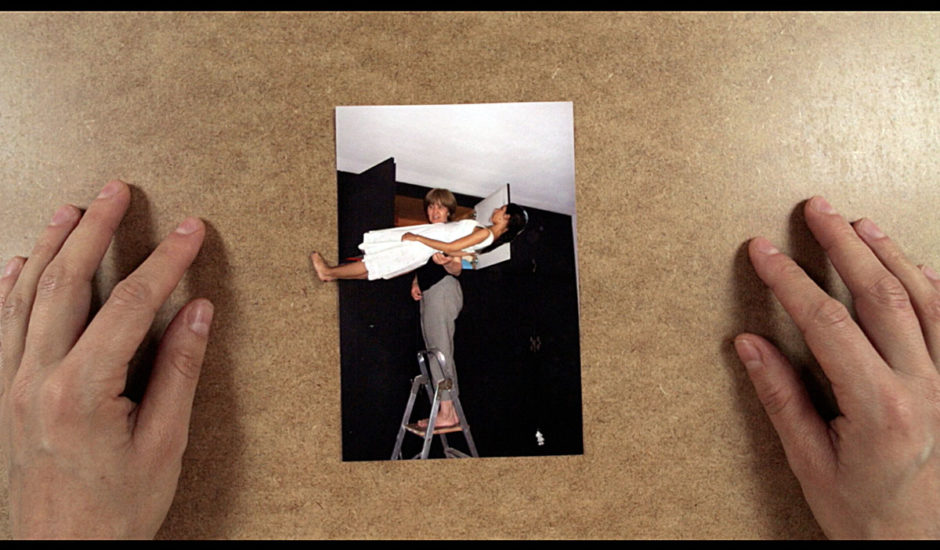
Both films (Letters 1 & Letters 2) show accounts by women migrants and their memories of early days in Denmark, where the central narrative is a series of letters and photographs exchanged between Pavlović in Copenhagen and her mother in Belgrade. Ana Pavlović was born in Serbia but has lived in Denmark since 1999. She graduated from the Royal Danish Academy of Fine Arts in Copenhagen.
Text by Hana Hasanbegović for MURMUR (full version on MURMUR website):
When artist Ana Pavlović was 22 years old, in 1999, she decided to leave her past in the rubble of her bombed-out Belgrade home and start a new life far to the north, in the promised lands of Scandinavia. With the exception of an estranged cousin, she didn’t know a soul when she arrived in Copenhagen, and had no idea how she was going to make ends meet.
Through the letters, we witness the development that the young women go through, as well as the experiences of the families left behind in the Balkans. We see how both sides develop coping mechanisms and survival strategies to deal with the impact of chasing a dream of a better life.
“Working with personal material is very difficult and emotional, especially when it’s personal items like these. Laying out your intimate letters, family photos and life story for people to freely interpret is a little messed-up. You’re afraid you’ll be judged – but that’s exactly why this work is important!” she says.
“My goal isn’t to tell some finite story about a group of women. It’s to put the material in a new context, so that we can view it from a different perspective and on a grander scale. I’m not afraid of exposing myself and my intimate life – I’m more afraid that people won’t care about this story and these shared experiences, because they’re not unique, and they’re definitely still around.”
The film Letters 1 & Letters 2 was screened during the seminar “Looking for another space of belonging” in Copenhagen, August 2019. More information here.
July 29th
Artwork: Zahida is a feminist, 2016
Artist: Đejmi Hadrović

The artist’s description:
The red thread of the project is the question of feminism in the Balkans, and how it is shaped through the occidental dominant white feminism. The issue I deal with is whether we can talk about emancipatory women’s practices in the Balkans without the implications of the western category of ideological and cultural practices. I give voice to women who are historically completely neglected from this point of view and presented through a single prism — the prism of the patriarchy. The fact that the Balkans is described by the West as patriarchal, traditional, rural, backward, mystical and scary is just one side of the story that has completely taken hold of our perception.
Tijana Mišković’s reflection on the work:
This artwork made me think about philosopher Rada Iveković’s argument that it is impossible to analyse the nation and the national without involving the notion of gender differences. Iveković argued that a feminist approach is absolutely unavoidable when trying to understand national constructions, because the nation is initially based on the difference between the sexes. The gender difference is the oldest known difference in humans. It does not automatically result in social inequality, but historically it has gone that way.
Nation means birth. The idea of a nation is about maintaining an identity and a single lineage — as pure as possible. Territory is considered the mother body to be defended. The woman is the nation, in a very essential and material way: her body is the nation. This is also why there have always been rapes in wars, including mass rapes. The notions of borders, nation, and gender are very interconnected.
July 28th
Artwork: Family Album, 2008
Artist: Suada Demirović
The artist’s description:
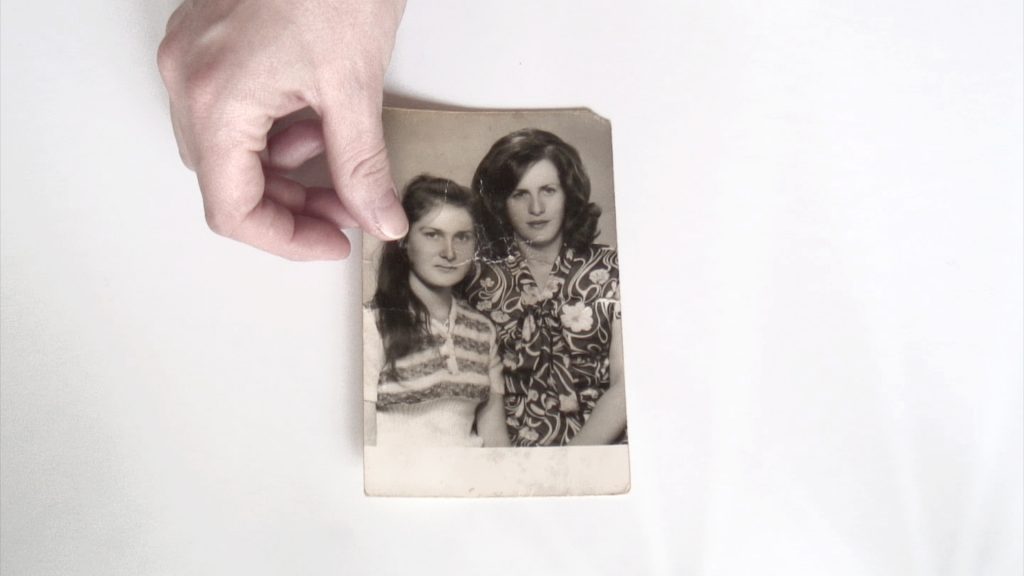
The work Family Album tells the story of my mother as a migrant. The video depicts both our hands as we go through the family album, from the year 1965–1982 — pre-1990s wartime in Yugoslavia. In 1970, Demirović’s mother moved to Denmark as part of a surge of guest workers — a country she had never heard of or even imagined living in. Her journey begins with overcoming the language barrier and being hired as a guest worker in the Danish chocolate factory, Toms.
The film Family Album was screened during the seminar “Looking for another space of belonging” in Copenhagen, August 2019. More information here.
July 27th
Artwork: Black Flags (Displacements), 2018
Artist: Neli Ružić
Excerpt from curatorial text by Janka Vukmir:
Neli Ružić introduces the exhibition by quoting Giorgio Agamben: “The ones who can call themselves contemporary are only those who do not allow themselves to be blinded by the lights of the century and so manage to get a glimpse of the shadows in those lights, of their intimate obscurity.”
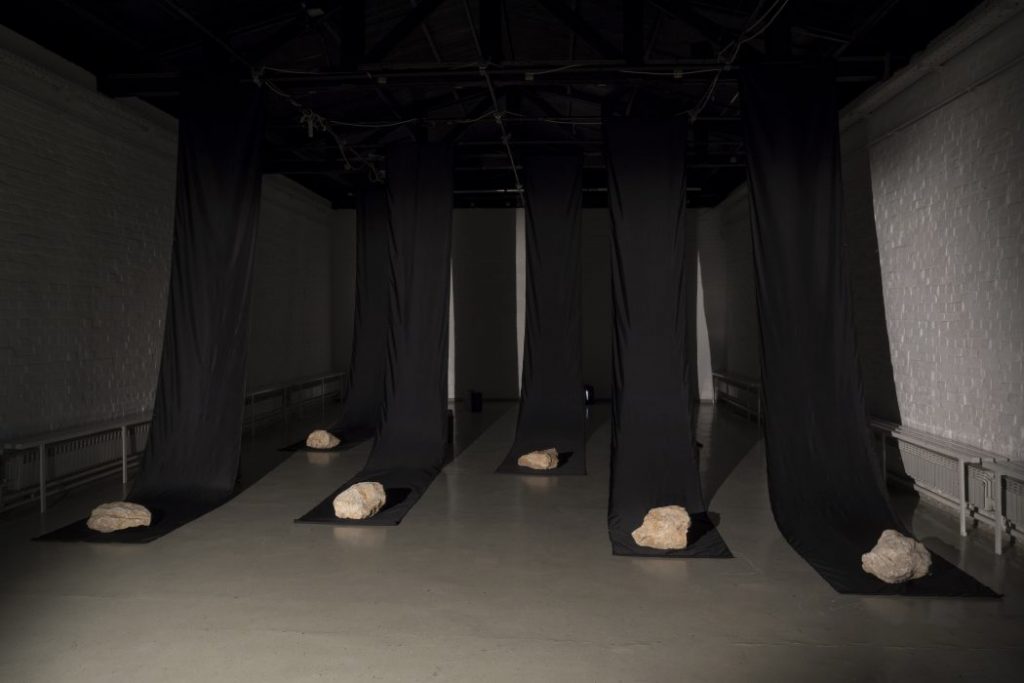
The single-room exhibition space of SC Gallery is mostly filled with flags hanging from high ceiling to the floor, creating a static, scenographical ambience. The flags are arranged upright using stones from the artist’s native island of Šolta, thus carrying rural connotations and contrasting the purity of the exhibiting space. Old suitcases are placed within the shaded fields, just open enough for a small amount of light to peep from their interior.
What migrations is Neli Ružić speaking of, in a country of constant economic and political emigration? She is speaking of their persistence, continuous departures and partings. Traces of light piercing from suitcases and reminding of different historical epochs suggest that life always finds a way. Everything fits into only four elements: flags, stones, suitcases and light-darkness — the century-old burden of social, political and migration weights.
July 26th
Artwork: Kulisa, 2012
Artist: Alen Aligrudić

The artist’s description:
“On the new side of the town, there is a replica of the old city. It looks like a coulisse for a movie and has become the city decoration and one part of the public urbanisation project. Since the coulisse is there, anyhow, the movie is about to be made. Or is it the other way around?”
Tijana Mišković’s reflection on the work:
A couple of years ago, an artist friend of mine from Bosnia used a coulisse as a metaphor to explain how the regime shift and the sudden civil war situation in Yugoslavia had left a lasting trace on his orientation in the world and his critical thinking. “Once you have seen the backdrop-coulisse fall down and you have discovered that the society you all your life have believed to be the reality is actually a constructed coulisse, you simply lose the innocence and naivety in your perception of the world.” Some kind of scepticism grows on you, and from that moment on you start questioning your surroundings, always looking behind “the coulisse”, checking the backside of the society being played out on the stage.
July 25th
Artwork: Misplaced Women?, ongoing since 2009
Artist: Tanja Ostojić
The artist’s description (from the project blog):
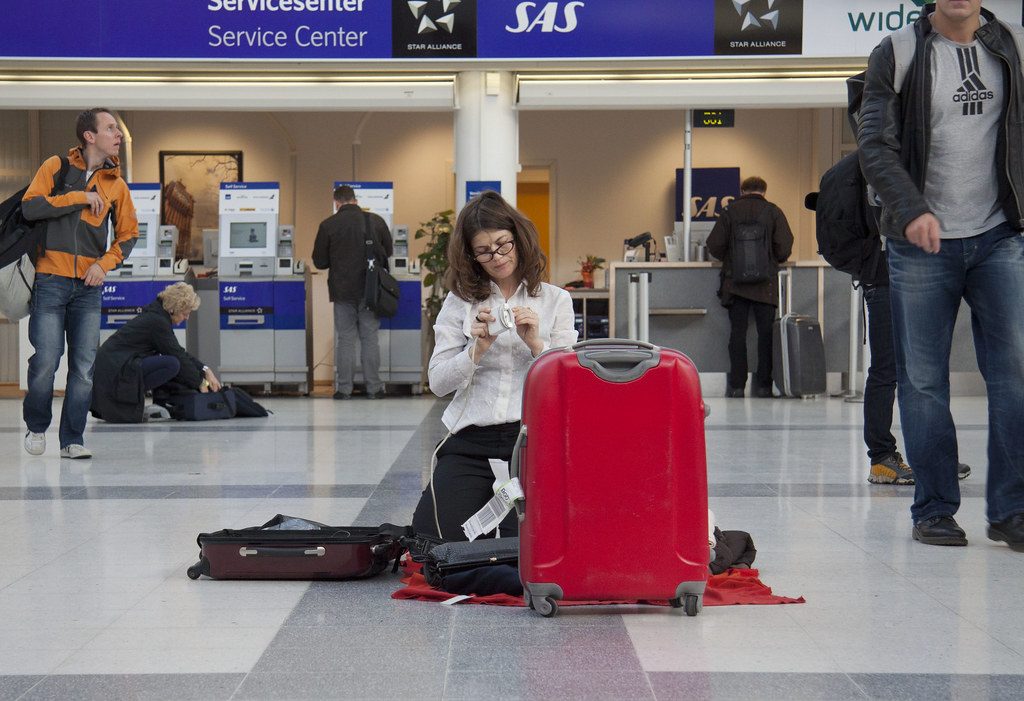
Misplaced Women? is an ongoing art project by Tanja Ostojić, Berlin-based internationally renowned performance and interdisciplinary artist of Serbian origin. The project consists of performances, performance series, workshops and delegated performances, ongoing since 2009. Within this project we embody and enact some of the everyday life activities that signify a displacement as common to transients, migrants, war and disaster refugees, as it is to the itinerant artists travelling the world to earn their living. Those performances continue themes of migration, desired mobility, and relations of power and vulnerability in regards to the mobile and in the first line female body.
Participants are invited to perform Misplaced Women? and to share their experiences on the web blog and during public discussions. Locations for performances include migration-specific places: train stations, airports, borders, underground, police stations, refugee camps, specific parks, prisons, etc. There are over 90 blog entries published since 2009.
July 24th
Artwork: Multiculturalists, please deal with the danish racism and leave us foreigners alone, 2018
Artist: Nermin Duraković

The artist’s description:
“Multiculturalists, please deal with the danish racism and leave us foreigners alone” is a poster project in public space realised in Copenhagen in 2018.
Tijana Mišković’s reflection on the work:
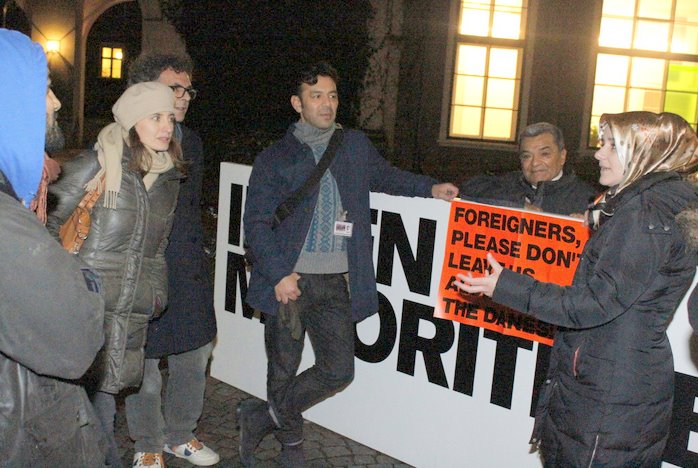
This artwork is a comment on a slogan by the art group Superflex — “Foreigners, please don’t leave us alone with the Danes” — which looks good as a foreigner-friendly poster-artwork but is problematic as an authentic welcoming message to foreigners.
In 2014 I discussed this artwork with The Art Delegation, a community of non-Danish artists actively working and living in Denmark. Orsolya Bagala, one of the delegation members, made an interesting point: the Superflex statement seemed provoking, because it was pointing at her as a foreigner by asking her not to leave, instead of pointing at the people who were forcing foreigners to leave. “The foreigners never wanted to leave,” she said, “but some of them simply got kicked out.” A second observation was about the populistic use of the poster: for some years, many people — even politicians — started using it, without really trying to make a change in their behaviour in order to include foreigners in their real life.
July 23rd
Artwork: Walking on the Water According to Dr. Kneipp, 1997
Artist: Nada Prlja
Text by Liljana Nedelkovska, Curator, NI Museum of Contemporary Art, Skopje, 2008:
Nada Prlja started her artistic activity at the end of the 1990s with a series of solo exhibitions in Skopje. Among these was Walking on Cold Water According to Dr. Kneipp, installed within the Institute of Physical Rehabilitation in Skopje in 1997. This installation functioned as a reenactment of the therapeutic healing methods developed by Dr. Kneipp, an 18th-century Bavarian priest and practitioner of alternative medicine. In one of the institute’s spaces, a series of female nightgowns were positioned in large, water-filled concrete basins; the white nightgowns were imprinted, in the area of the chest/heart, with drawings of Dr. Kneipp’s healing methods. In an adjacent space, floating above a vast metallic tub for water treatment, another nightgown was installed onto which, instead of an imprinted drawing, the flickering image of a video was projected.
What was so fascinating about this exhibition was the combination between the fragility and vulnerability of the represented body — the sensuality, sadness, fear, pain and melancholy imprinted on the whiteness of the gowns — with the incredible presence of the real space itself. This combination highlighted the transition from the real towards the virtual space, marking not only the exteriority of the body but also its interiority — and there, where one would expect to find a sense of fulfilment, paradoxically a void or rift appears. This is why the wound can never heal, and the pain cannot disappear.
July 22nd
Artwork: Repriza/Uzvraćanje (Reprise/Response), 2018
Artist: Damir Avdagić

The artist’s description:
In Repriza/Uzvraćanje (Reprise/Response), four people in their mid-60s, originally from Ex-Yugoslavia, perform a transcribed conversation from the piece Reenactment/Process (2016), in which four people in their mid-20s discuss the inter-generational frictions they experience between themselves and their parents, relating to the conflict in Ex-Yugoslavia. The participants react to the content, commenting on issues of responsibility, guilt, shame and the legacy of communism in the wake of the conflict. Together, the two works stretch a historical time period between two generations and reflect on how the past echoes in the present.
The film was screened during the seminar “Looking for another space of belonging” in Copenhagen, August 2019. More information here.
July 21st
Artwork: Bigger Than Life
Artist: Adnan Softić

In Skopje, a government plan costing several hundred million euros is creating a brand new, ancient city centre — the project is called “Skopje 2014.” Some thirty government buildings and museums, as well as countless monuments in the classic style, have been erected in the Macedonian capital in an attempt to put Skopje on a par with Rome and Athens. A city looks for a future in history — Macedonia is inventing itself as a nation with historical status based on a model of antiquity that never existed in that form.
In Bigger Than Life, present-day Skopje becomes an archaeological dig. We can follow in real time how history is made, how antiquity is constructed, how historical singularities are manufactured via mimicry, and how the boundary between truth and falsification becomes blurred the minute something is recorded often enough on postcards.
Author/Director: Adnan Softić. Cinematography: Helena Wittmann, Adnan Softić. Editing: Nina Softić. Music: Daniel Dominguez Teruel, Adnan Softić.
The film was screened during the seminar “Looking for another space of belonging” in Copenhagen, August 2019. More information here.
July 20th
Artwork: Greetings from Montenegro, 2007–2009
Artist: Alen Aligrudić
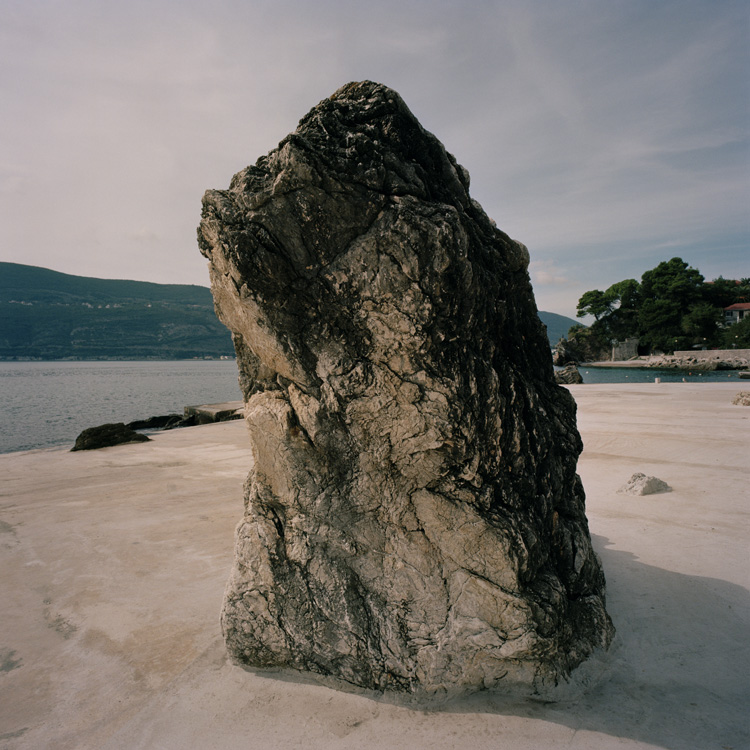
In 2006 Montenegro was the last of the republics in the former Yugoslavia to proclaim its independence. Alen Aligrudić wanted to document the changes after that historic moment, and travelled through the largely empty country. From the first day of independence, foreign investors have been buying up the land and real estate. The Mediterranean climate makes the ground so desirable that the lure of turning a quick profit on it has destroyed rural life and the agrarian sector.
Tijana Mišković’s reflection on the work:
At the moment, I’m in Svendborg — a harbour town in southern Denmark. Several times a day I go to the sea and look at the boats. The question that has been circling my mind is: What is local, and what is global?
Often I feel my personal feeling of belonging is based on experiences — what could also be called “experiential nearness”, characterised by the fact that it functions across space and time. Sometimes I can feel more connected to places and people far away from me, or to historical moments that took place far before I was born. This is experiential locality — an open kind of particular locality which, for a moment, could look like the idealized concept of universality.
Alen Aligrudić’s photograph came to my mind several times today. Sometimes I felt like I was the big rock in his artwork — stocked, heavy, and unmovable, but wanting to sail away into the open sea. And in other moments, I thought that the rock is not a physical thing, but a living being that represents an accumulation of our experiences. The more we experience, the more open our locality becomes.
July 19th
Artwork: The Didactic Wall, 2019
Artist: Mladen Miljanović

Tijana Mišković’s reflection on the work:
Two days ago I came back to Copenhagen after spending two short days in the border town of Bihać, where refugees are trying to cross the border from Bosnia to Croatia daily. I took part in a round table discussion organised by curator Irfan Hošić in connection to the Mladen Miljanović exhibition.
During the event, I was looking at the long gallery space. On one side there was a wall with the relief-like artwork in shiny stone with drawings of people moving through the border zone. On the other side, there were windows through which one could see people walking up and down the pedestrian street. It was like seeing a mirror reflection with a twist, showing art on one side and the reality on the other.
Suddenly a woman from the audience said that in the building just across the street from the gallery, at that very same moment, local politicians were also debating the refugee situation — but from a very different point of view. Instead of creating helping manuals for survival, they were trying to develop rules for making life more difficult for refugees. That is when I discovered that we were sitting in the limbo-space of in-betweenness I was referring to.
Text by Irfan Hošić on The Didactic Wall:
The Didactic Wall by Mladen Miljanović is a subversive educational installation focusing on the issue of migrants, refugees, displaced persons and apatrids. This is an engaged set of illustrations addressing directly those who, in an “illegal” way, are trying to cross national borders. The trigger for conception of this work is the massive halt of migrants and refugees in Bihać as a result of the literal closing of the green border by the Croatian border service.
The visual language Miljanović uses originates from military literature of the former Yugoslav People’s Army. By carving his drawings into stone, the artist underlines the social importance of the message and its present significance. The solidity of stone also offers a sacral dimension, inevitably reminding of the Moses’ Commandments. The Didactic Wall is thus an indestructible monument to empathy and social responsibility.


July 18th
Artwork: Worth of Gold When a Home is Made, 2007
Artist: Saša Tatić
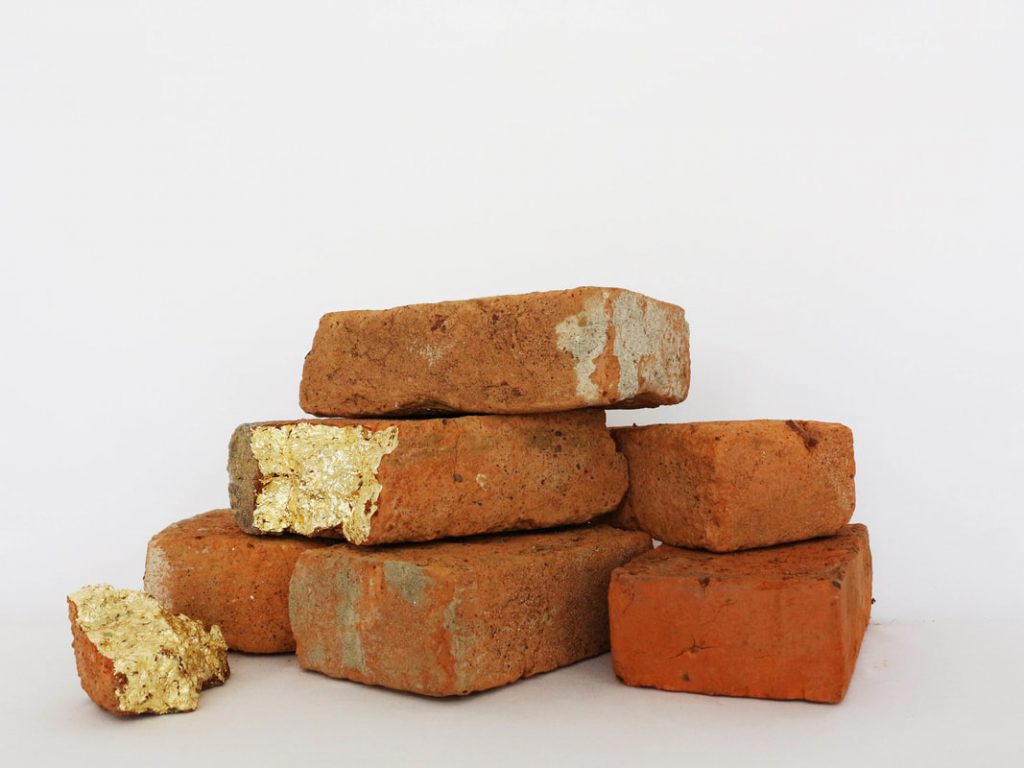
Old bricks, previously used as material for construction of a house, still hold the potential for its recreation — a habitual place commonly accepted as home. As the identical content of two photographs, with a small intervention that created a “before and after” relation, they ask for recognition of fundamental values which under the flux of life often stay hidden and forgotten.
Tijana Mišković’s reflection on the work:
This artwork carries a concept of potential in a possible construction, but visually the bricks remind me as much of construction elements as they remind me of ruins. This is probably why the Tower of Babel came to my mind — not religiously, but rather as a model for thinking about language, which can lead to mutual understanding as well as misunderstanding.

July 17th
Artwork: Bosnian House Konak, 2012 (revised 2017)
Artist: Amel Ibrahimović

Model house design in collaboration with Maria Engholm (2012) and Iben Bach (2017). Photo credit: Torben Eskerod (2017), Marcel Stammen (2012), Anja Franke (2012). Supported by the Danish Art Workshops.
Tijana Mišković’s reflection on the work:
Konak is a word that refers to a guesthouse — the generous welcoming gesture of a place to stay. The artist inherits the concept of the house from his father. He transforms drawings made by his father in Bosnia, before the war, into a three-dimensional model developed in Denmark, where he escaped to as a refugee. The model is still only a sketch — not a real house. Maybe this ideal house should never become a real house. Maybe it should remain as a model of potentiality, maintaining the aspect of not-yet-realised possibilities.
July 16th
Artwork: House Museum, 2007
Artist: Katarina Šević

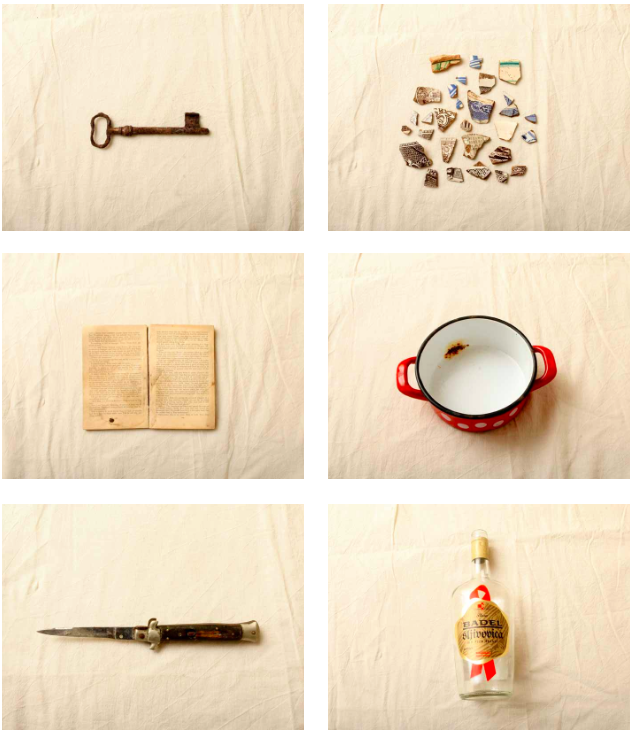
House Museum is built upon a story of a house situated on peninsula Pelješac in Dalmatia, Croatia. By adopting an archaeological approach, this project explores questions of collective heritage, storytelling, value systems, and expanded notions of the past and the present. In 2003, Serbian citizens were allowed for the first time — after the fall of Yugoslavia — to enter Croatian territory without visas. My family’s summer house was built in 1972, in Žuljana. When we found it again in 2004, only the flat roof and the walls were left. We have decided to catalogue the found objects and organise them into the “House Museum.”

July 15th
Artwork: (Re)arranging, 2009/2015
Artist: Nermin Duraković

(Re)arranging is an installation composed of furniture from the 1990s Danish asylum centre, arranged and rebuilt in the same creative manner that the residents of the asylum centres often employed to optimise their living conditions.
Tijana Mišković’s reflection on the work:
I believe that everybody who lived in a typical Danish refugee camp in the beginning of the 90s remembers these red metal structures. My parents, my brother, and I lived in a room like that for nearly three years. For a person coming from war and a state of emergency, where their power to make life decisions is taken from them, the only thing left is to reorganise the few possible things in their everyday life. The creativity and improvisation — even though very limited — stimulate a feeling of freedom and give an impression of being able to step out of an imposed frame.
July 14th
Artwork: Transition, 2010
Artist: Ana Pavlović

A mixed media artwork, 200 x 200 x 200 cm, made of wood, oil paint, collected objects, video and sound.
The starting point for this project is an actual kiosk which can be found in Belgrade, Serbia. The original kiosk was made in the 1970s in former Yugoslavia and was state property during the socialist period. Today, more than 30 years later, some of these kiosks survived the many political changes, war, sanctions and economic transitions, and they are still standing. The government is working on removing them and replacing them with new ones owned by large corporations.
Tijana Mišković’s reflection on the work:
The modernism of Yugoslavia was monumental and temporary. And the kiosk is part of that story — a design classic and part of Yugoslavian heritage, created by Saša Mächtig from Slovenia and part of MoMA’s architecture and art collection since the 1970s.
Ana manages to transform the small kiosk from a mobile service unit into a capsule that can also translocate us in time and place — travelling back to a time of socialism in Yugoslavia, while also transmitting the culture happening in present-day Serbia. Just like the title indicates, the kiosk is the architectural object being and representing a transition.
July 13th
Artwork: Subliminal Family Architecture, 2010–2013
Artist: Mladen Bundalo
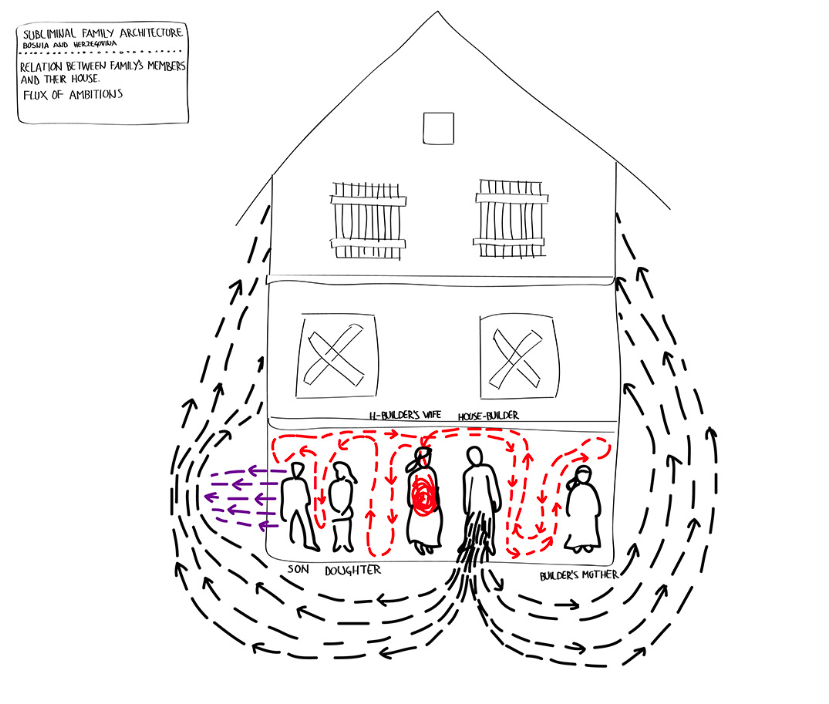
A series of photos and drawings. A drawing booklet related to the project can be seen here.
After the civil war devastation, large ethnic migrations were completed within the territory of Bosnia and Herzegovina. New land was given to refugees who embarked on the construction of houses. Entire towns with tens of thousands of family houses — conceptualised in an identical or very similar manner — emerged. The dominant principle includes plans for a house of big dimensions, upgrading through a longer period due to a lack of finances and a strong drive to build up floors that might host further families of the male children.
Tijana Mišković’s reflection on the work:
It is fascinating how much the architecture of a home affects the psychological state of mind and the interactions between its residents. By linking the project to the specific context of post-war Bosnia and Herzegovina, the artist draws a socio-political line which opens up critical questions related to belonging to a family as a genetic entity and belonging to a nation as an ethnicity and national entity.
July 12th
Artwork: Flotel Europa, 2015 (70 min)
Artist: Vladimir Tomić

In 1992 a wave of refugees from the war in Bosnia and Herzegovina reached Denmark. With existing refugee camps completely full, the Red Cross pulled a giant ship into the canals of Copenhagen. The ship, Flotel Europa, became a temporary home for a thousand people waiting for decisions on their asylum applications. Among them was a 12-year-old boy, Vladimir, who fled Sarajevo together with his mother and older brother. They spent two years in the limbo of Flotel Europa. Two decades later, Vladimir Tomić takes us on a journey of growing up on this ship filled with echoes of the war.
Tijana Mišković’s reflection on the work:
Since my own family belongs to the wave of refugees who came to Denmark from Bosnia and Herzegovina and were placed in floating refugee camps in Copenhagen in the beginning of the 90s, I cannot help but feel connected to the stories told in this artwork.
There is something very symbolic about the ships that functioned as floating refugee camps. Everything was constantly in motion — we were living on water instead of steady ground, constantly feeling the boat rocking, witnessing the shaky emotional state of those living on the boat and the frustration of being on board without sailing in any direction.
July 11th
Artwork: The ROBEL, 2008
Artist: Danica Dakić
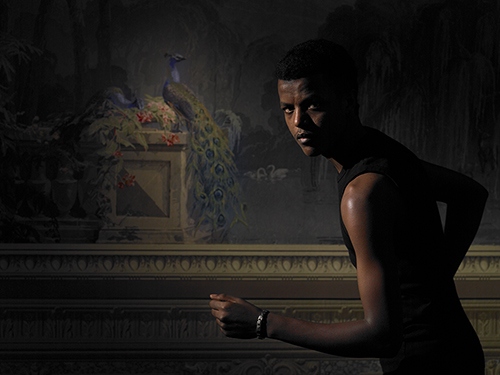
The ROBEL (2008) is a C-print on aluminium from a photo series related to the video installation El Dorado.
Tijana Mišković’s reflection on the work:
When I saw the video installation El Dorado in Kassel at Documenta 12, it made an immediate impression on me. The juxtaposition of young underage migrants from a refugee camp in Kassel and the idealized, dream-like backdrop of the same town’s wallpaper museum was such an evocative setting.
Apart from being a visual backdrop, the museum rooms and labyrinth-like architecture also act as a historic and cultural backdrop, encapsulating topics such as colonialism and exotica, putting the situation the young immigrants find themselves in into another perspective. Throughout the video, there are several overlaps between the presence of the “real” immigrant-protagonists and the “unreal” museum universe. Wallpaper is a fake decorative surface of the wall, and as such it automatically refers to the idea of camouflaging something more real but “less decorative.”
From the video, I especially remember a young African boy running through the museum — the artwork The ROBEL is a portrait of him. This running action, which does not belong to the museum’s indoor setting, created a strong impact and left me with an almost physical feeling of claustrophobia. The boy was very alive and compared to him, the museum space and its limited architecture seemed lifeless. It was like seeing a bird trapped in a cage.
July 10th
Artwork: Replanting the Roots, 2016
Artist: Nenad Milčević

Video, 7:13 min — view here. The video shows the process of planting an exotic palm tree on a beach in Denmark.
Tijana Mišković’s reflection on the work:
I would like to use the word passage to analyse this “replacement of roots,” which metaphorically illustrates the physical and mental space many foreigners go through — the passage from the life they had in their own country and culture to the new country and culture in which they must be integrated.
To explain cultural transition rituals, such as the rite of passage, Victor Turner uses the three-part model developed by Arnold van Gennep: (1) the separation, (2) the liminality (the transition), and (3) the incorporation (the return). In the first phase, people are separated from their usual environment. In the second phase, they are placed in a limbo-like zone. Then in the third phase, they return to normality — but in a changed state.
Another tool for analysing this artwork is the word “translation,” from the Latin lātus (ferre), meaning to bear or carry. Due to the prefix trans- (across, through or beyond), the word “translation” has a direction that needs two poles: the source and the target. In our example, it is the people being “translated”/”carried over” who are made passive and unable to decide about their life because their destinies are left to an invisible power that only manifests itself indirectly in the form of political decisions.
July 9th
Artwork: NO SPACE, 2019
Artist: Selman Selma

An online video and research project. View here.
The artist’s description:
The work NO SPACE
is superpositionally
about every possible space
and about all possible people.The main idea of the work is to
bring the world back
to thinking about the physical realities of Earth
by visualizing how space and belonging
are conceptualized today.While using a virtual planet
and making my body both
bigger than the Earth,
and as small as your phone screen,
I am questioning our conceptions of
physical space and personal belonging.
Tijana Mišković’s reflection on the work:
There is nothing space- or territory-bounded about Selman Selma, the Bosnian artist of Roma origins, who today lives and works between several countries. There is an aura of freedom around her both as a person and as an artist.
Seeing the Earth from space is an awe-inspiring experience called the “overview effect” — a feeling that automatically changes our self-consciousness as humans and shakes our concept of belonging to a culture, country, religion, or other identity-related segments, which in the perspective of Earthrise seem insignificant.
It looks like a motif from The Little Prince, only her outfit is different. Instead of an otherworldly cape, she wears a down-to-earth workers’ jacket with high visibility neon, creating an intelligent critique of capitalism. In the video, the artist is all the time looking and talking to the camera — to us — which makes the self-reflection stronger. We simply start laughing at ourselves for being ridiculously stuck in a traditional mindset of belonging to a territory, ownership of land, and national identification.
July 8th
Artwork: From Line of the Horizon, 2017
Artist: Ismar Čirkinagić

Part of a larger spatial installation including video and audio elements. For price and more information, send an email.
Tijana Mišković’s reflection on the work:
The sculptural elements in this artwork are war debris and ruins — pieces of bricks and stone fragments from demolished buildings collected from war hotspots around the world. Like beads on a string, they are positioned side by side, creating an order and system that seems absurd when thinking of the chaotic contexts each element comes from. What at first glance might seem like a result of an almost senseless necessity for systematic precision is, in fact, the artist’s attempt to reenact an Obsessive-Compulsive Disorder (OCD) routine that appears as a consequence of PTSD.

The fact that the war debris are collected from different parts of the world moves the concept of war above the national contexts and onto a more universal level. This element of unity in the artwork finds its inspiration in John Donne’s Meditation XVII: No man is an island (1624):
No man is an island
entire of itself;
Every man is a piece of the continent,
a part of the main;
Any man’s death diminishes me,
because I am involved in mankind.
And therefore never send to know for whom
the bell tolls; it tolls for thee.
This artwork has a dual strength: the precision when it comes to specific socio-political contexts, where the original war debris become almost forensic evidence — and at the same time, a universal interpretation related to nature, even diving into the geological sphere of petrology, dealing with the origin, structure, and composition of the stones.
July 7th
Artwork: From YU: The Lost Country, 2011–2013
Artist: Dragana Jurišić

C-print, 70 x 70 cm, Edition of 8 + 2 AP. For price and more information, send an email.
The artist’s description:
Yugoslavia fell apart in 1991. With the disappearance of the country, at least one million five hundred thousand Yugoslavs vanished, like the citizens of Atlantis, into the realm of imaginary places and people. Today, in the countries that came into being after Yugoslavia’s disintegration, there is a total denial of the Yugoslav identity.
At Easter 2011, I started retracing Rebecca West’s journey through Yugoslavia — initially described in her 1937 masterpiece Black Lamb and Grey Falcon — re-interpreting it through photography and text, in an attempt to re-live my experience of Yugoslavia and to re-examine the conflicting emotions and memories of the country that was.
Tijana Mišković’s reflection on the work:
This picture is taken in Kosovo, somewhere around Kosovska Mitrovica. On the shore, we see a pair of almost decomposed denim. Like an organic-shaped sculpture, they are slowly becoming part of the landscape. When worn, with time, cloth takes the shape of a human body. When the body is gone, the cloth is left behind as a physical form representing a memory of a person who no longer exists. Both cloth and skin tissue represent the membrane that separates the body from its surroundings. Skin is probably our only real and unquestionable place of belonging.
July 6th
Artwork: Central Europe 1815–2000, 2005
Artist: Suada Demirović

Video work, 02:15 min. Exhibited at the Royal Danish Academy of Fine Arts and The Betty Nansen Theatre.
Tijana Mišković’s reflection on the work:
The map in the artwork is changing as if in a constant pulsing rhythm of a person breathing. The borderlines are moving as if they were dancing, which makes it difficult to take them seriously as constant borders. The aspects of objectivity and neutrality, when it comes to cartographically visualising reality, are shaken.
The map shows the region of Central Europe and its border development for the last couple of centuries — about where the Balkans lies. Balkans is the so-called country of “blood and honey” (etymologically from the Turkish combination of “bal”, meaning blood, and “kan”, meaning honey). This contrasting nature of the name can also be recognised in descriptions of the Balkans as the subconsciousness of Europe — a region that is exotic and compelling on one hand, while at the same time being unpredictable and frightening.
Maps are normally used for orientation. We translate a geographic space, which is impossible to overview with the pure eye, into a concrete drawing and visual illustration — translating something abstract into something concrete. My father often told me stories from his school time in former Yugoslavia about how, in Geography class, students were asked to draw neat, freehand drawings of the maps of the country. The children were drawing an idea of the territory rather than the territory itself — and today, when Yugoslavia does not exist any more, their free-hand drawings might be considered more relevant and authentic than the official maps.
July 5th
Artwork: Broadway Boogie-Woogie, 2006
Artist: Nebojša Šerić
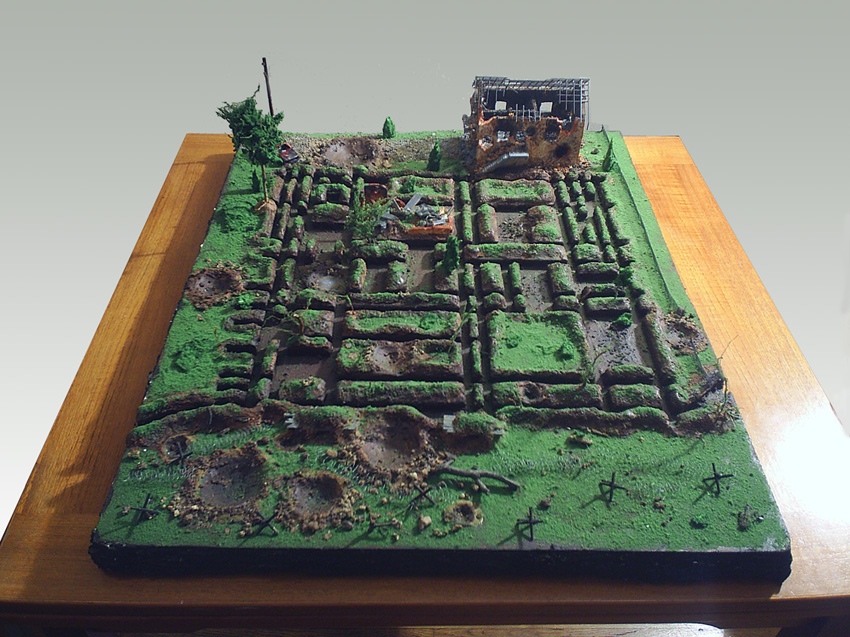
Ready-made sculpture. Plasteline, plaster, wood, foam.
The artist’s description:
This is a scale model of the trenches I tried to dig during the time when I was drafted into the war in Bosnia. As a soldier, I began to dig the trenches in the shape of Piet Mondrian’s painting Broadway Boogie Woogie. Unfortunately I was immediately arrested by security officers. I did not succeed in explaining to the officers that this act of digging was actually an art project made on the front lines. This project reconstructs my memory of those years, and the actual battlefield where I happened to be — because I couldn’t choose not to be there.
Tijana Mišković’s reflection on the work:
Its model-like size and form make the artwork look like a children’s board game. The design-like combination of lines and squares indicates that there should be certain rules of the game, even though the mission of the game remains unknown. The terrain is divided into sections, either for agriculture purposes (fields) or for war purposes (trenches) — as if there is not much difference between a planted field and a battlefield. It is as if the land is being simultaneously cultivated and ruined.
The organised manner of visualising a chaotic war action and turning a serious situation into a playful game might be the artist’s method of coping with the irrationality of war.
July 4th
Artwork: Herbarium, 2017
Artist: Ismar Čirkinagić

A series of framed herbariums in various sizes. Parts of the series have been exhibited at ARoS Triennale — THE GARDEN, Liverpool Biennial / City States, Vantaan Taidemuseo Artsi and Pulse Miami Beach. One part of the series has been purchased by Sorø Kunstmuseum, another part is in ARoS Aarhus Art Museum. For price and more information, send an email.
Tijana Mišković’s reflection on the work:
For more than ten years, I have worked with Ismar Čirkinagić — an artist from Bosnia and Herzegovina who often expresses the brutality of the Balkan war through subtle and aesthetic artworks related to nature.
In Herbarium, the artist presents dried plants collected from the locations of mass graves in Bosnia and Herzegovina, not far from his hometown. The collected plants are neatly pressed in the traditional botanical preservation method. They are each accompanied by information regarding not only the Latin name and plant family, but also the names of the mass graves the plants were collected from, and how many bodies were found in the graves.
Conceptually, the artist illustrates how the deceased human body becomes nurture for grass and plants, taking on a new form of life. He puts the course of nature and its resilience in contrast to the rupture of life’s circle caused by human brutalities such as war. The juxtaposition of society and nature underlines two different perspectives of our being in the world: the existential human belonging to nature — alongside animals and plants — versus a more constructed perspective of belonging to a society or a nation.
July 3rd
Artwork: 551.35 – Geometry of Time, 2014
Artist: Lana Čmajčanin
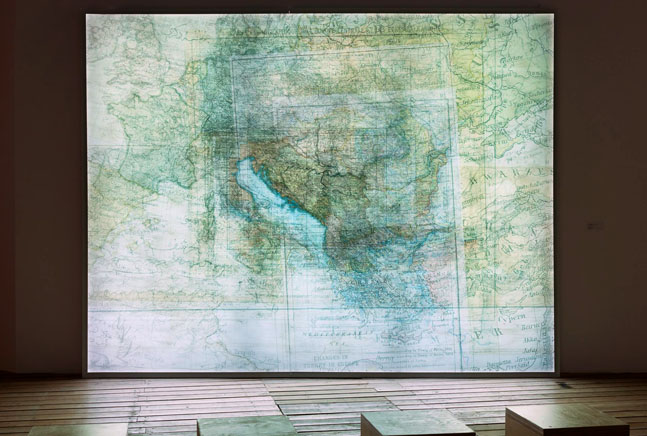
Installation — lightbox, print on Barrisol canvas, 306 x 395 x 25 cm. Edition 4/2. One edition is part of the Arteast 2000+ International Collection, MG+MSUM, Museum of Modern Art + Museum of Contemporary Art, Ljubljana, Slovenia. For price and more information, send an email.
The artist’s description:
551.35 – Geometry of Time confronts us with various delimitations of the territory of Bosnia and Herzegovina, whose borders were set and changed following dynamic and intense historical processes. It points out the social and political reality of Bosnia and Herzegovina by illuminating the conflictual and unstable nature of its territory. Since the density of marks makes the borders unclear, the work can be read as an overlapping of all previous text that results in illegibility — an inability to consider the sovereignty and statehood of this area through the numerous layers of the past.
Tijana Mišković’s reflection on the work:
This artwork deals with the mapping of land — both as national territories and as lithospheric parts of the earth. On one of the images, the map motive seems blue and looks almost like a map of water rather than land. This makes me think about the sea and the fact that the concept of territorial belonging for people living on an island surrounded by sea might be quite different from the widely held land-based sense of identity of those living inside the continent. For an islander, the national border is the coastline — a natural meeting point between the hydrosphere and lithosphere, and an open liminal space of all sorts of exchange and crossings.
July 2nd
Artwork: Uprootedness
Artist: Nenad Milčević
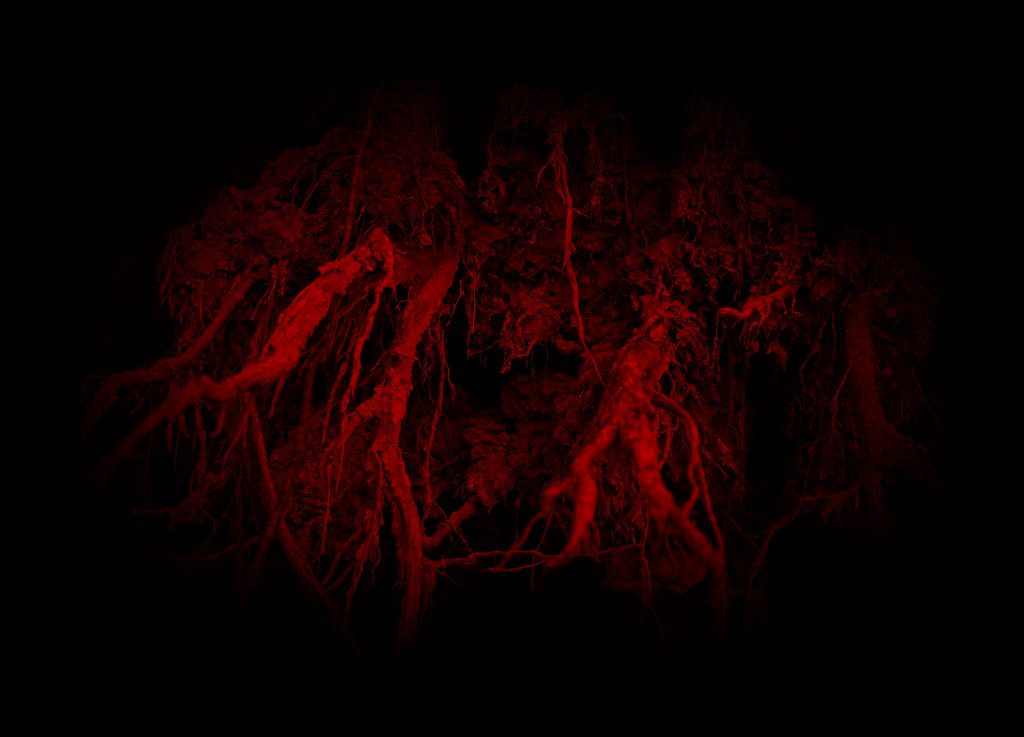
Photo series / lightbox installation, 1 x 1.5 m. For price and more information, send an email.
Tijana Mišković’s reflection on the work:
The subterranean motive of Uprootedness seems more alive the more I look at it — probably owed to the dominant red colour, which makes the roots look like veins in a living organism. The blood red colour also indicates death, even though uprootedness is not necessarily an act of destruction. It is rather an act of relocation, in which the destiny of the plant is to be decided by its adaptability to a new environment. I wonder how big a role the adaptability of the moved “plant” plays compared to the capability of the new environment to accept it — and of course, this makes me think about integration.
July 1st
Artwork: Burned Field, 2017
Artist: Mila Panić

Exists as both a video artwork and a photo series. For price and more information, send an email.
The artist’s description:
The video is recorded in real time, showing the intentional burning of the field. The work presents the field which is supposed to be mine one day, as a family inheritance. We burn crops and weeds on our fields after the autumn harvest — an annual (illegal) process to clear and fertilize the land for the next year. Our relationship to the landscape often speaks of a longing for the land we are familiar with, which was, or is ours, and has defined our sense of ourselves. With this work, I am asking what my responsibility is towards my heritage and inheritance.
Tijana Mišković’s reflection on the work:
The artwork had an immediate effect on me — I was attracted by the cosy, home-like fireplace sound in the video, while at the same time I feared that the fire could lose control at any moment. This both beautiful and frightening burning motive made me think about Limbo and then, Diaspora.
Limbo derives from the Latin word limbus, meaning border — it is not Hell, but it is not Heaven either. Since its place as a hypothetical concept in the Middle Ages, Limbo has theologically become a “real” third space. Just like in the case of diaspora, the distance could be seen as a beneficial tool that maintains a tension between the things it separates, allowing the introduction of a new third space: “inbetweenness” (l’entre) as an existential and ontological condition. According to philosopher François Jullien, “The distance maintains a tension between the things it separates and the established distance brings forth the inbetweenness. If the ‘between’ is the thing of which ontology cannot conceive — because it has no in-itself: i.e., no essence — it is also the space through which the thing passes, or occurs: the space of the operatory and the effective.”